Inverter pool heat pumps
The upgrade over a single-speed heat pump is real. The efficiency figures used to sell it are mostly not, and one manufacturer is the honorable exception.
Quick picks
Ranked on whether the efficiency claim can be checked, then on output. Live prices come from the retail listing.
| # | Product | Best for | Price |
|---|---|---|---|
| 1 | 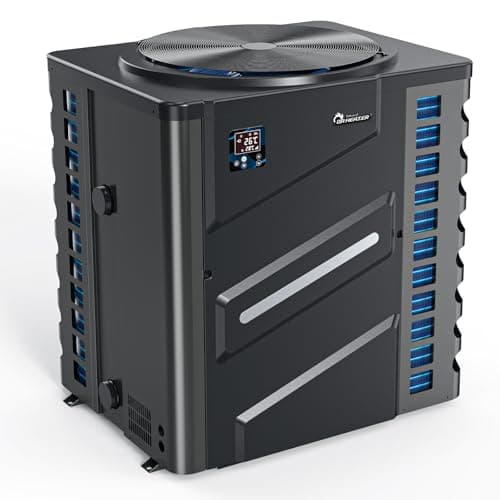 Best overall Dr. Infrared DR-1100HP 110,000 BTU Full DC Inverter Pool Heat Pump 110,000 BTU, CSA and AHRI certified, and the only efficiency claim on this site you can verify from the maker's own published inputs. | An inground pool to about 32,000 gallons, for a buyer who wants the efficiency figure to be checkable | |
| 2 | 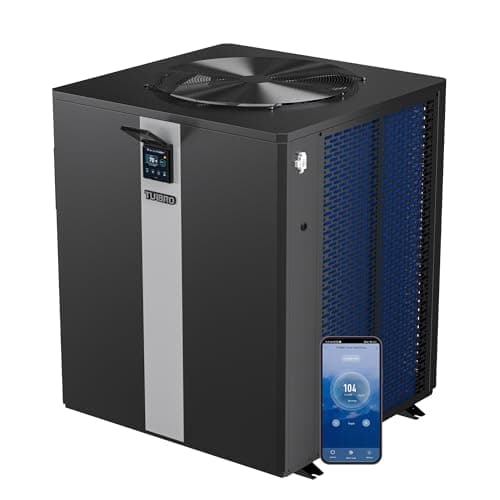 Most output TURBRO Beluga B160V 143,450 BTU Full DC Inverter Pool Heat Pump 143,450 BTU for pools to 40,000 gallons, with vertical discharge that removes the front clearance. Ignore the 'COP up to 14.67'. | A large inground pool where a 140,000 BTU class unit is the right size | |
| 3 | 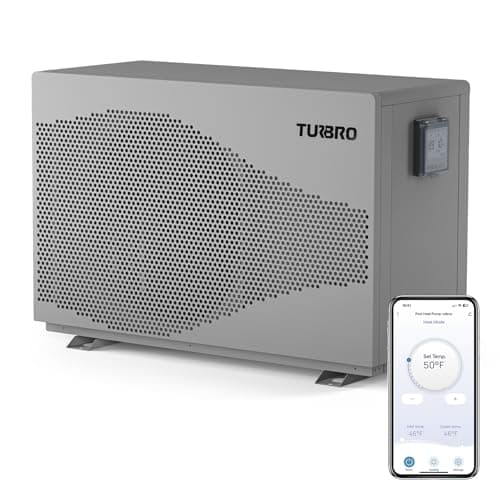 Best small inverter TURBRO Beluga B33V 33,000 BTU Inverter Pool Heat Pump 33,000 BTU for above-ground pools to 10,000 gallons, 5-year compressor cover. | An above-ground pool of 6,000 to 10,000 gallons with a 240V supply | |
| 4 | 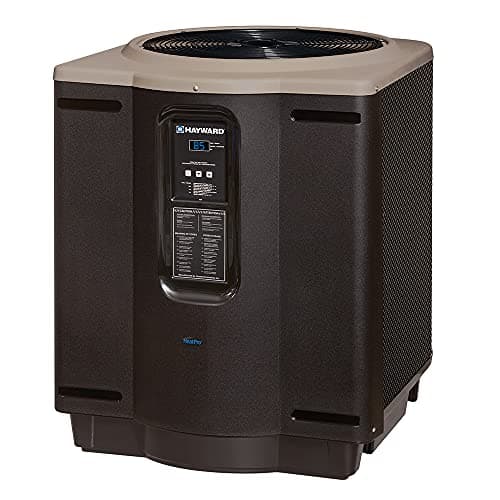 The single-speed benchmark Hayward HeatPro Pool Heat Pump 140,000 BTU, no inverter and no published COP at all. This is what an inverter is being compared against. | Lowest running cost per degree when you want real temperature control | |
| 5 |  Cheaper than any efficiency upgrade Sun2Solar 1600 Series Ultimate Blue Solar Cover Modulating a heat pump saves a fraction. Not losing the heat overnight saves more, for a fiftieth of the price. | An inground pool you cover most nights, every season |
#ad We earn a commission if you buy through this link, at no extra cost to you. It never changes the ranking. How this site is funded. Prices last checked October 17, 2026.
What an inverter actually changes
A conventional pool heat pump has one speed: on. It runs at full output until the thermostat is satisfied, stops, and starts again when the water drops. An inverter model varies compressor speed instead, running slowly and continuously to hold a temperature.
Three genuine consequences, none of which is controversial:
- It is more efficient at part load. A compressor loafing at 30% moves heat more efficiently per watt than one cycling on and off. This is real physics, not marketing.
- It is quieter, because most of the time it is not running flat out.
- It is easier on the compressor and the grid — fewer start-up surges, and soft-start circuitry on the units here.
What it does not change is the physics of getting a cold pool warm. From cold, an inverter runs at full output like anything else, and takes the same hours our heating time calculator gives you.
The COP problem, and why this page exists
Because an inverter’s efficiency climbs as it throttles down, manufacturers can quote a coefficient of performance measured at minimum output — the machine idling — and print it as the headline. The numbers that result are spectacular and useless.
| Unit | Claimed efficiency | Inputs published? | Our reading |
|---|---|---|---|
| Dr. Infrared DR-1100HP | Equivalent of 540% (COP about 5.4) | Yes — 110,000 BTU/hr output and 0.61-5.9 kW input | Checkable, and it checks out. See the arithmetic below. |
| TURBRO Beluga B160V | COP up to 14.67 | No | Not usable. No test condition, no electrical input, nothing to verify against. |
| TURBRO Beluga B33V | COP up to 15.8, cited to AHRI 1160 | No | Cites a standard but publishes no inputs. A part-load figure. |
| Hayward HeatPro (single speed) | None published | n/a | The category norm, and not a mark against it — most established brands publish nothing. |
A COP without either a stated test condition or the inputs to derive it is a marketing number. This is the first table on this site where a manufacturer comes out ahead by publishing MORE rather than claiming more.
For context, the established brands publish either nothing at all or a single figure without inputs. Our brand comparison covers who publishes what, and AquaCal is the only established maker that states the condition its COP was measured at.
Is an inverter worth the extra money?
The honest answer depends entirely on how you run the pool.
| How you use the pool | Inverter? | Why |
|---|---|---|
| Hold a temperature all season | Yes | This is the case an inverter is built for — long hours at part load, which is exactly where its efficiency advantage lives. |
| Heat from cold for occasional weekends | No | From cold it runs flat out like any other unit. You are paying for a part-load benefit you never use. |
| Equipment pad close to a bedroom or a neighbor | Yes | The noise difference at part load is the most reliably noticeable benefit. |
| Shoulder-season use in cool air | Maybe | Inverters generally hold output better in cold air, but none of these listings publishes performance at a stated low temperature. |
Nobody publishes a seasonal figure for any of these, so this table is reasoning from how the technology works rather than from measured savings. Treat it that way.
What to check before you buy one
- Certification. The Dr. Infrared unit states CSA and AHRI; the TURBRO B160V states UL. These are the only third-party marks in this group and they are worth more than any COP claim.
- Compressor warranty, stated separately. TURBRO publishes 2 years on the unit and 5 on the compressor. Dr. Infrared publishes 3 years on components with no separate compressor term, which is worth asking about on a four-figure machine.
- Airflow direction. The B160V discharges vertically, which removes the five to six feet of front clearance a side-discharge unit needs. On a tight equipment pad that can be the deciding factor.
- Weight and the pad. The Dr. Infrared unit is 276 lb. Our page on replacing a pool heater covers the base it has to sit on.
- Exchanger material. All the inverters here state titanium, which keeps a salt pool on the table — see heaters for saltwater pools.
The cheaper efficiency upgrade
Modulating a compressor saves a percentage of the electricity a heat pump draws. Covering the pool cuts the heat you lose in the first place, which DOE puts at 50 to 70% of heating cost. One of those is a several-hundred dollar upgrade on a several-thousand dollar machine; the other costs under two hundred dollars and works on any heater you own.
Buy the cover, then decide about the inverter with the smaller heat load you now have.
Every pick, in detail
What each one publishes, what is good and bad about it, and — the section this category usually omits — what we could not judge without owning one.
Dr. Infrared DR-1100HP 110,000 BTU Full DC Inverter Pool Heat Pump
The only heat pump we have found whose efficiency claim you can check against its own published numbers, and that alone puts it at the top of this category. Dr. Infrared states 110,000 BTU/hr, an input range of 0.61-5.9 kW, and an 'efficient equivalent of 540%'. Divide it out: 5.9 kW is 20,131 BTU/hr of electricity, and 110,000 divided by that is 5.46. The claim and the inputs agree. CSA and AHRI certified, twin rotary compressor modulating from 20 to 100%, and a 3-year component warranty.
Best for An inground pool to about 32,000 gallons, for a buyer who wants the efficiency figure to be checkable
| Rated output | 110,000 BTU/hr | Manufacturer |
|---|---|---|
| Stated efficiency | Equivalent of 540%, i.e. a COP of about 5.4Unusually, the listing publishes the electrical input alongside it, so the claim is checkable rather than asserted. | Manufacturer |
| Our check of that claim | 110,000 BTU/hr ÷ (5.9 kW x 3,412 BTU/kWh) = 5.46The published output and the published maximum input agree with the published 540% to within rounding. That is the first time on this site a manufacturer has given us enough to verify its own efficiency number. | Our arithmetic |
| Pool size the maker names | Up to 32,000 gallons, inground or above-ground | Manufacturer |
| Electrical | 208-230 Vac, 2.65-25.6 A, 0.61-5.9 kW | Manufacturer |
| Compressor | Twin rotary, full DC inverter, modulating 20-100% | Manufacturer |
| Certification | CSA and AHRI | Manufacturer |
| Weight | 276 lb | Retail listing |
| Warranty | 3-year limited component | Manufacturer |
- Publishes enough to let you verify its own efficiency claim — effectively unique here
- CSA and AHRI certified, and states the modulation range rather than just 'inverter'
- USA-based support stated on the listing
- 3-year component cover with no separately stated compressor term
- Heavier than comparable units at 276 lb, so the pad matters
- The 540% is still a best-case figure with no air temperature attached
- The air temperature the 540% was measured at
- COP at the 20% modulation floor, which is where an inverter spends most of its life
- Long-term reliability of the twin rotary compressor
These need a unit in hand across a season. We do not have one, so we do not have an opinion worth printing on them.
#ad We earn a commission if you buy through this link, at no extra cost to you. It never changes the ranking. How this site is funded. Prices last checked October 17, 2026.
TURBRO Beluga B160V 143,450 BTU Full DC Inverter Pool Heat Pump
The largest heat pump on this site by output, and the one with the least believable efficiency claim. 143,450 BTU/hr for pools to 40,000 gallons, a titanium exchanger, a microchannel coil, UL certification and 2-year unit / 5-year compressor cover — all of that is real and competitive. Then the listing says 'COP up to 14.67', with no test condition and no inputs to check it against. Buy it for the output, the warranty and the vertical discharge, which removes the front clearance a conventional unit needs. Do not buy it for the 14.67.
Best for A large inground pool where a 140,000 BTU class unit is the right size
| Rated output | 143,450 BTU/hr maximum | Manufacturer |
|---|---|---|
| Claimed COP | Up to 14.67No test condition is stated and no electrical input is published, so there is nothing to check it against. An inverter's COP climbs steeply as it throttles down, so an 'up to' figure describes the machine idling. Not comparable with the 5.0-5.9 established brands publish at full load. | Manufacturer |
| Pool size the maker names | Up to 40,000 gallons — 39 ft round or 26 x 46 ft | Manufacturer |
| Heat exchanger | Titanium, stated as salt and chlorine resistant | Manufacturer |
| Airflow | Vertical discharge with 3-sided intakeGenuinely useful: it removes the 5-6 ft front clearance a side-discharge unit needs, which matters on a tight equipment pad. | Manufacturer |
| Operating range | 46-104°F water, in 14-109°F air | Manufacturer |
| Certification | UL | Manufacturer |
| Warranty | 2-year full unit, 5-year compressor | Manufacturer |
- Highest published output of any heat pump we rank
- Vertical discharge removes the front clearance requirement
- UL certification and a separately stated compressor term
- The 'COP up to 14.67' claim has no conditions and no inputs to verify it
- 2 years on the full unit is short for a four-figure machine
- TURBRO is an import brand with no long parts record to check
- Full-load COP, which is not published
- Inverter board reliability outdoors over several seasons
- Parts availability in five years
These need a unit in hand across a season. We do not have one, so we do not have an opinion worth printing on them.
#ad We earn a commission if you buy through this link, at no extra cost to you. It never changes the ranking. How this site is funded. Prices last checked October 17, 2026.
TURBRO Beluga B33V 33,000 BTU Inverter Pool Heat Pump
The step up: 33,000 BTU/hr, a DC inverter compressor, WiFi, and a 5-year compressor warranty against the 2 years on the machine. It is the most capable above-ground heat pump we found at anything like this money. It is also where the COP claim gets silly — the listing says 'up to 15.8', which is a part-load inverter figure and not comparable with the 5.0 to 5.9 the US brands publish at full load. Buy it for the 33,000 BTU and the warranty, not for the 15.8.
Best for An above-ground pool of 6,000 to 10,000 gallons with a 240V supply
| Rated output | 33,000 BTU/hr | Manufacturer |
|---|---|---|
| Claimed COP | Up to 15.8, cited to AHRI Standard 1160 (I-P)An inverter's COP rises steeply as it throttles down, so an 'up to' figure describes the machine loafing, not the machine heating your pool from cold. The full-load number is what matters and TURBRO does not publish it. Treat 15.8 as incomparable with the 5.0-5.9 the established brands quote. | Manufacturer |
| Heat exchanger | Titanium | Manufacturer |
| Compressor | Full DC inverter | Manufacturer |
| Pool size the maker names | Up to 10,000 gallons — round to 20 ft, rectangular to 12 x 24 ftTURBRO explicitly says it is not recommended for inflatable pools, because of low water pressure. | Manufacturer |
| Operating range | 46-104°F water, in 5-109°F air | Manufacturer |
| Control | WiFi app and programmable timer | Manufacturer |
| Warranty | 2-year full machine, 5-year compressorThe compressor term is the meaningful one, and 5 years is competitive with the established brands. | Manufacturer |
- 33,000 BTU/hr is enough to actually hold temperature on a 10,000-gallon pool
- 5-year compressor warranty, which is the part that fails
- Inverter control means it modulates instead of cycling on and off
- The 'up to 15.8' COP claim is not comparable with any figure on this site
- Needs 240V, which removes the plug-in advantage of the smaller model
- Not recommended by TURBRO for inflatable pools
- Full-load COP, which the maker does not publish
- Inverter board reliability outdoors over several seasons
- How the WiFi control behaves if the app is discontinued
These need a unit in hand across a season. We do not have one, so we do not have an opinion worth printing on them.
#ad We earn a commission if you buy through this link, at no extra cost to you. It never changes the ranking. How this site is funded. Prices last checked October 17, 2026.
Hayward HeatPro Pool Heat Pump
If you are heating a pool with electricity, this is the shape of machine to do it with. A heat pump moves heat instead of making it, and at the assumptions we publish it delivers a million BTU into the water for about a fifth of what an electric resistance heater costs to deliver the same. It is slower than gas and it fades as the air gets colder, which is exactly when you want it — that trade is the whole decision.
Best for Lowest running cost per degree when you want real temperature control
| Type | Air-source heat pumpThe manufacturer publishes no retrievable specification sheet; figure is as listed at retail. | Retail listing |
|---|---|---|
| Rating convention | Rated by BTU/hr OUTPUTThis is the trap in the category. Gas heaters are rated by fuel INPUT, heat pumps by heat OUTPUT. A 140,000 BTU heat pump and a 140,000 BTU gas heater do not deliver the same heat. | Published standard |
| Cost per million BTU delivered | About $10.75 at our published assumptionsUS average residential electricity at 18.34 cents/kWh (EIA, June 2026) and an assumed COP of 5.0. Both are substitutable on our running-cost calculator. | Our arithmetic |
- Cheapest running cost per delivered BTU of any controllable heater
- No gas line, no combustion, no flue
- Holds a set temperature rather than depending on the weather
- Slow — expect most of a day to move a full-size pool ten degrees
- Efficiency falls with air temperature, so it is weakest in the shoulder season
- High purchase price against a gas heater of comparable output
- The COP this specific unit achieves at your conditions
- Compressor and control-board longevity
- Noise at the distance your deck actually sits from it
These need a unit in hand across a season. We do not have one, so we do not have an opinion worth printing on them.
#ad We earn a commission if you buy through this link, at no extra cost to you. It never changes the ranking. How this site is funded. Prices last checked October 17, 2026.
Sun2Solar 1600 Series Ultimate Blue Solar Cover
The cover to buy if you intend to keep using it in five years. 16 mil is the thickest tier the category sells, and thickness on a solar cover buys durability rather than heat — Bob Vila measured every cover in its hands-on group at the same 4 to 5 degrees, from 12-mil clear to 16-mil blue. Pay the extra for the one that survives being dragged over the coping twice a day, not for a temperature difference that did not show up in the only published one-hour test in this category.
Best for An inground pool you cover most nights, every season
| Price shown for | 24 ft roundThis product is sold in several sizes on one listing. The live price and photograph on this page are the ones Amazon returns for this variant; other sizes are priced separately. | Retail listing |
|---|---|---|
| Thickness | 16 milThe manufacturer publishes no retrievable specification sheet; figure is as listed at retail. | Retail listing |
| Color | Blue | Retail listing |
| Stated lifespan | 5 to 10 years for the 16-mil tierSwim University's published figure for 16-mil covers generally, not a Sun2Solar warranty statement. | Retail listing |
| Bubble side | Bubbles face the waterCategory-wide instruction, not brand-specific. The bubbles are the insulating layer and they have to touch the water. | Published standard |
4 to 5 degrees F in one hour
Claimed by Bob Vila, measured across all covers in their group. Conditions: One hour under 2pm sun on 89 to 92 degree F days. Source
Their figure was the same for every cover they put on the water. Read our reconciliation of what a one-hour reading actually measures before you plan around this number.
- Thickest tier sold, which is where the durability difference actually is
- Blue absorbs more of the incoming energy at the surface than clear does
- Cuts oversize to your pool shape with household scissors
- Heavy and awkward at 16 mil — a large inground cover is genuinely a two-person job without a reel
- Costs meaningfully more than the 12-mil version for no measured heating advantage
- Whether the seams hold up over five seasons of daily handling
- How the bubble layer survives repeated dragging over rough coping
- Whether the stated lifespan tier holds for this specific product line
These need a unit in hand across a season. We do not have one, so we do not have an opinion worth printing on them.
#ad We earn a commission if you buy through this link, at no extra cost to you. It never changes the ranking. How this site is funded. Prices last checked October 17, 2026.
Questions people actually ask
Is an inverter pool heat pump worth it?
Can a pool heat pump really have a COP of 15?
What is the difference between inverter and variable speed pool heat pumps?
Do inverter heat pumps work better in cold weather?
- Average retail price of electricity to US residential customers: 18.34 cents/kWh, June 2026U.S. Energy Information Administration · read 2026-09-02
- US residential natural gas price: $24.09 per thousand cubic feet, June 2026U.S. Energy Information Administration · read 2026-09-02
- US residential propane price: $2.674 per gallon, week ending 30 March 2026U.S. Energy Information Administration · read 2026-09-02
- Energy content conversion factors: 3,412 BTU per kWh, 1,036 BTU per cubic foot of natural gas, 91,452 BTU per gallon of propaneU.S. Energy Information Administration · read 2026-09-02
- U.S. Department of Energy pool-energy figures (evaporation share, BTU per pound evaporated, cover savings, recommended temperatures, wind effect)Recreonics, reproducing and attributing the U.S. Department of Energy · read 2026-09-02
- Pool heater roundup: the 8.33 BTU per gallon per °F figure, attributed on the page to Alicia Toedter of Leslie'sBob Vila · read 2026-09-02
- Dr. Infrared Heater DR-1100HP listing: 110,000 BTU full DC inverter, rated for pools to 32,000 gallons, 208-230 Vac with a stated draw of 2.65-25.6 A and 0.61-5.9 kW, 'efficient equivalent of 540%', twin rotary compressor modulating 20-100%, CSA and AHRI certified, 276 lb, 3-year limited component warrantyDr. Infrared Heater, as listed at retail · read 2026-09-27
- TURBRO Beluga B160V listing: 143,450 BTU max output, full DC inverter, titanium heat exchanger, microchannel coil, vertical discharge, operating range 46-104°F water in 14-109°F air, UL certification, WiFi and TFT touchscreen, 2-year full unit / 5-year compressor warranty, and a claimed 'COP up to 14.67'TURBRO, as listed at retail · read 2026-09-27
- TURBRO Beluga B33V listing: 33,000 BTU full DC inverter, titanium heat exchanger, WiFi, rated for pools to 10,000 gallons, 2-year machine / 5-year compressor warranty, claimed 'COP rating up to 15.8 (AHRI Standard 1160(I-P))', and explicitly not recommended for inflatable poolsTURBRO, as listed at retail · read 2026-09-20
- Hayward W3HP21405T HeatPro listing: 140,000 BTU, titanium heat exchanger, 230V, 33.6 x 30.5 x 44 in, 250 lb, stated as compatible with saltwater poolsHayward, as listed at retail · read 2026-09-20
#ad Where a retailer’s listing is cited above as the source of a published specification, that link is an affiliate link, at no extra cost to you. Independent sources and manufacturer documentation are never wrapped and earn nothing. How this site is funded.
Every URL above was fetched and returned content on the date shown. Where a figure is ours rather than somebody else’s, the arithmetic is on the page and on the methodology page. If you find an error in it, we would genuinely like to know.
Read next
Pool heat pumps worth buying
Full-size and small heat pumps ranked on published output, exchanger material and what the manufacturer will actually say about efficiency. With the sizing math for your pool.
Pool heater brands, compared
Hayward, Pentair, Raypak, Jandy, AquaCal and FibroPool at brand level: what each builds, what each publishes, and which to shortlist.
Hayward HeatPro review
The full-size heat pump this site uses as its benchmark. Titanium exchanger, explicit saltwater compatibility, no published COP, and two live listings with different part numbers.
What a pool heat pump costs to run
The heat pump running-cost derivation, what happens to it in cold air, and the two inputs that change the answer more than anything else.
Pool heaters for saltwater pools
Salt corrodes the one part of a heater you cannot replace cheaply. Titanium against cupro-nickel against copper, and the heaters that state which they use.
TURBRO pool heat pump review
The Manatee M18, Beluga B33V and Beluga B160V on the record: what TURBRO publishes, what its COP numbers are worth, and the hours-to-temperature arithmetic for each.