Does a solar cover pay for itself?
The calculation nobody in this category publishes, worked end to end. For most heated pools the answer is measured in weeks.
Quick picks
The cover the arithmetic assumes, plus the accessory that decides whether it happens at all.
| # | Product | Best for | Price |
|---|---|---|---|
| 1 | 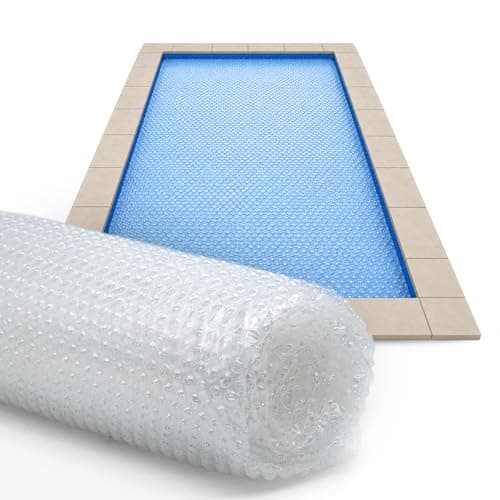 The one to buy Sun2Solar 1200 Series Crystal Clear Solar Cover 12-mil clear, our overall pick. The payback below assumes roughly this price. | Most pools, most budgets — the default recommendation | |
| 2 | No photo Extends the payback and is still worth it Blue Wave Solar Cover Reel Adds to the cost, and without it the cover often stops going on — which makes the payback infinite. | Any inground pool with a cover you are not using enough | |
| 3 | 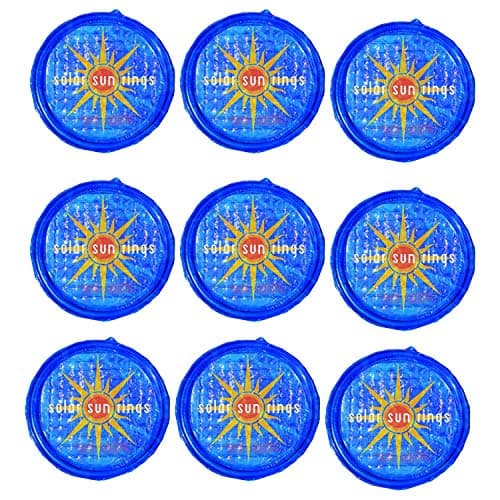 Faster payback, smaller effect Solar Sun Rings Start with two. Partial coverage pays back proportionally. | A pool you would otherwise leave uncovered because the blanket is too much work |
#ad We earn a commission if you buy through this link, at no extra cost to you. It never changes the ranking. How this site is funded. Prices last checked October 18, 2026.
The one measurement you need
Read your pool temperature at dusk and again at dawn, a foot down and away from the return jets. Do it on a still, clear night, which is the worst case and the one a cover helps most.
That difference is your overnight loss, and it is the only input this calculation genuinely needs. Everything else is published.
The calculation, worked end to end
| Step 1 — heat lost: 20,000 x 8.33 x 3 | = 499,800 BTU |
| Step 2 — evaporation share: x 70% (DOE) | = 349,860 BTU |
| Step 3 — a cover addresses that share | |
| Step 4 — value of it: x $28.36 per million BTU | = $9.92 a night |
| Step 5 — a cover costs about $130 | |
| Step 6 — payback: $130 ÷ $9.92 |
About 14 nights — under two weeks
Step 2 is the ceiling rather than a guarantee: a cover cannot stop every gram of evaporation, particularly at the edges. But DOE's own published saving from covering a pool when it is not in use — 50 to 70% of heating cost — is consistent with capturing most of it, and even at half this rate the payback is under a month.
The same pool on a heat pump
Cheaper heat means slower payback, and that is worth being straight about.
| 349,860 BTU a night | |
| x $10.75 per million BTU | = $3.76 a night |
| $130 ÷ $3.76 |
About 35 nights — around five weeks
Still inside a single season by a wide margin, and the cover then keeps paying for another three to four years on its published lifespan tier.
Sensitivity: your pool is not the example
| Overnight drop | 10,000 gal (gas) | 20,000 gal (gas) | 20,000 gal (heat pump) | 30,000 gal (gas) |
|---|---|---|---|---|
| 1°F | 79 | 40 | 104 | 27 |
| 2°F | 40 | 20 | 52 | 14 |
| 3°F | 27 | 14 | 35 | 9 |
| 5°F | 16 | 8 | 21 | 6 |
Nights of active heating, not calendar days. Assumes a $130 cover and that a cover captures the full 70% evaporation share — halve the effect and double the numbers, and every single cell is still inside one season.
When it does not pay back
Being honest about the cases where this argument fails:
- An unheated pool. If you never pay to heat the water, there is no heating bill to save. A cover still keeps the pool warmer and cuts water and chemical use — DOE puts those at 30 to 50% and 35 to 60% respectively — but the payback arithmetic above does not apply.
- A cover you do not use. The payback is infinite. This is not a rhetorical point: it is the commonest outcome, and it is why a reel belongs in this calculation for any pool big enough to need one.
- A very short season. If you heat for four weeks a year, a cover on a heat pump may not clear its cost in season one. It will in season two.
Beyond the heating bill
The calculation above only counts heat, which understates the case. DOE also publishes that a cover reduces make-up water by 30 to 50% and chemical consumption by 35 to 60%. Both of those are real money on a metered supply, and neither is in any of the numbers above.
Run this with your own figures — your gallons, your overnight drop, your fuel, the price you were actually quoted.
Every pick, in detail
What each one publishes, what is good and bad about it, and — the section this category usually omits — what we could not judge without owning one.
Sun2Solar 1200 Series Crystal Clear Solar Cover
The value pick, and the one whose logic actually holds up. A clear cover transmits more sunlight into the body of the pool instead of absorbing it at the surface, and 12 mil is the point where lifespan stops being the limiting factor. Bob Vila measured this and the 16-mil blue at the same 4 to 5 degrees in an hour, so you are paying less for the same measured result and giving up some years of service life.
Best for Most pools, most budgets — the default recommendation
| Price shown for | 20 x 40 ft rectangleThis product is sold in several sizes on one listing. The live price and photograph on this page are the ones Amazon returns for this variant; other sizes are priced separately. | Retail listing |
|---|---|---|
| Thickness | 12 milThe manufacturer publishes no retrievable specification sheet; figure is as listed at retail. | Retail listing |
| Color | Clear | Retail listing |
| Stated lifespan | 3 to 4 years for the 12-mil clear tierSwim University's published figure for 12-mil clear covers generally. | Retail listing |
| Bubble side | Bubbles face the water | Published standard |
4 to 5 degrees F in one hour
Claimed by Bob Vila, measured across all covers in their group. Conditions: One hour under 2pm sun on 89 to 92 degree F days. Source
- Clear transmits more light into the water instead of stopping it at the surface
- 12 mil is the sweet spot: real service life without 16-mil bulk
- Cheaper than the 16-mil tier with no measured heating penalty
- Shorter published lifespan tier than 16 mil
- A clear cover shows algae and debris more obviously, which some people dislike
- Whether clear genuinely outlasts or under-lasts blue in the same thickness
- Real-world tear resistance at a pool with rough edges
- How much the clear material clouds over a season of UV
These need a unit in hand across a season. We do not have one, so we do not have an opinion worth printing on them.
#ad We earn a commission if you buy through this link, at no extra cost to you. It never changes the ranking. How this site is funded. Prices last checked October 18, 2026.
Blue Wave Solar Cover Reel
A reel is the single highest-leverage purchase in this whole category and almost nobody frames it that way. Every DOE saving figure assumes the cover is on the pool when the pool is not in use. A cover that takes two people and five minutes comes off on Friday and goes back on in October. A reel turns that into thirty seconds alone, which is the difference between the savings existing and not.
Best for Any inground pool with a cover you are not using enough
| Type | Wheeled above-ground-style reel for inground and above-ground useThe manufacturer publishes no retrievable specification sheet; figure is as listed at retail. | Retail listing |
|---|---|---|
| Why it matters | Converts a two-person five-minute job into a one-person thirty-second jobOur framing, not a manufacturer claim. The published savings all assume the cover is actually on. | Our arithmetic |
- Turns the cover into something you will genuinely use daily
- Keeps the cover off the ground, which is where covers get damaged
- Wheels, so it moves out of the way
- Costs a real fraction of what the cover itself costs
- Takes up deck space permanently
- Assembly is fiddly on every reel in this category
- How the tube and hardware hold up outdoors across seasons
- Whether the width range covers your pool without a wobble
- Assembly quality and hardware fit
These need a unit in hand across a season. We do not have one, so we do not have an opinion worth printing on them.
#ad We earn a commission if you buy through this link, at no extra cost to you. It never changes the ranking. How this site is funded. Prices last checked October 18, 2026.
Solar Sun Rings
Floating discs you drop on one at a time instead of wrestling a full blanket, sold individually. That convenience is the whole product, and it comes out of the physics: rings leave gaps, and evaporation carries on through every square foot you did not cover. Expect a fraction of a full cover's effect roughly in proportion to the surface you actually covered, and buy them because you will use them, not because they work better.
Best for A pool you would otherwise leave uncovered because the blanket is too much work
| Price shown for | One 60-inch ringSolar Sun Rings list this 60-inch ring by pack count, each pack its own listing: single, 3, 6 and 9. The live price and photograph on this page are the ones Amazon returns for the single-ring listing; the multi-ring packs are priced separately and work out cheaper per ring. | Retail listing |
|---|---|---|
| Coverage | Partial — discs leave gaps between and at the edgesThe gap is not a defect, it is how the product works. It does mean the DOE cover-saving figures do not apply at full strength. | Published standard |
| Typical price | About $40 to $55 each, or about $150 and up per multi-ring packRead from the brand's own current Amazon listings on 2026-10-12: $54.99 for the single ring, and $149.97, $269.94 and $359.91 for the 3, 6 and 9-ring packs — about $40 to $50 a ring as the pack gets larger. Check the live price before buying. | Retail listing |
- One person can put them on and take them off in a couple of minutes
- No reel, no folding, no dragging anything over the coping
- Buy a few at a time instead of committing to one large purchase
- Partial coverage means partial results — the gaps keep evaporating
- Per square foot of coverage they cost far more than a blanket
- Wind moves them around
- How much surface a given number of rings really covers on your pool shape
- How long the material lasts against a full blanket
- Whether the anchoring holds in a breeze at your site
These need a unit in hand across a season. We do not have one, so we do not have an opinion worth printing on them.
#ad We earn a commission if you buy through this link, at no extra cost to you. It never changes the ranking. How this site is funded. Prices last checked October 18, 2026.
Questions people actually ask
Does a solar cover pay for itself?
How much does a solar cover save per month?
Is a solar cover worth it on an unheated pool?
- Average retail price of electricity to US residential customers: 18.34 cents/kWh, June 2026U.S. Energy Information Administration · read 2026-09-02
- US residential natural gas price: $24.09 per thousand cubic feet, June 2026U.S. Energy Information Administration · read 2026-09-02
- US residential propane price: $2.674 per gallon, week ending 30 March 2026U.S. Energy Information Administration · read 2026-09-02
- Energy content conversion factors: 3,412 BTU per kWh, 1,036 BTU per cubic foot of natural gas, 91,452 BTU per gallon of propaneU.S. Energy Information Administration · read 2026-09-02
- U.S. Department of Energy pool-energy figures (evaporation share, BTU per pound evaporated, cover savings, recommended temperatures, wind effect)Recreonics, reproducing and attributing the U.S. Department of Energy · read 2026-09-02
- Pool heater roundup: the 8.33 BTU per gallon per °F figure, attributed on the page to Alicia Toedter of Leslie'sBob Vila · read 2026-09-02
Every URL above was fetched and returned content on the date shown. Where a figure is ours rather than somebody else’s, the arithmetic is on the page and on the methodology page. If you find an error in it, we would genuinely like to know.
Read next

Is a pool heater worth it?
The pre-purchase doubt, answered with arithmetic: what a heater costs to run per week of swimming you actually gain, when the honest answer is no, and the cheaper thing to try first.
Solar cover savings calculator
Turns your pool's overnight temperature drop into a saving per night, per season, and a payback period — the calculation nobody in this category publishes.
Solar pool covers worth buying
Ranked on the specifications that actually differ between covers — thickness tier and published lifespan — because the only hands-on test in this category found no heating difference at all.
Do solar pool covers work?
The 4-degrees-versus-15-degrees contradiction that runs through this entire category, reconciled from published physics. Three different quantities being reported as one.
How much does it cost to heat a pool?
The complete cost model: what a million BTU costs to deliver with each fuel, what that means per degree and per pool size, and why heat-up cost is not your monthly bill.
Solar cover vs pool heater
A hundred-dollar cover against a three-thousand-dollar heater, and the measurement that tells you which half of the problem you actually have.
How fast a pool loses heat
Evaporation, radiation, convection and conduction, with the arithmetic on what each night actually costs and a measurement you can take yourself.