Pool heaters for saltwater pools
One component decides this, and most listings mention it in passing if at all. Here is what the heat exchanger material changes, and which heaters name theirs.
Quick picks
Chosen on one criterion above all others: what the manufacturer says the heat exchanger is made of.
| # | Product | Best for | Price |
|---|---|---|---|
| 1 | 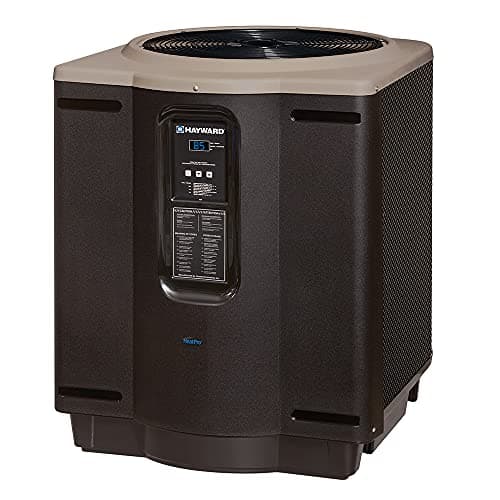 Best overall for salt Hayward HeatPro Pool Heat Pump Titanium exchanger, and Hayward states saltwater compatibility and coastal durability in writing rather than leaving it implied. | Lowest running cost per degree when you want real temperature control | |
| 2 | 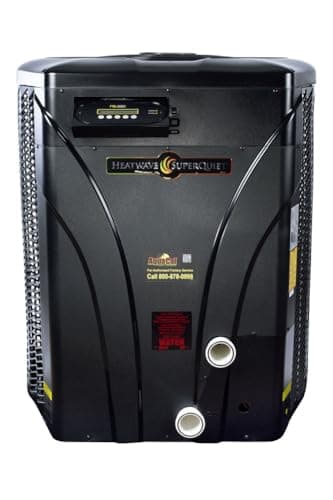 Best if you want a published efficiency figure AquaCal HeatWave SuperQuiet SQ160R Pool Heat Pump ThermoLink titanium, plus the only COP on this site that comes with the air temperature it was measured at. | A full-size pool where the titanium exchanger, app control and warranty are worth paying for | |
| 3 | 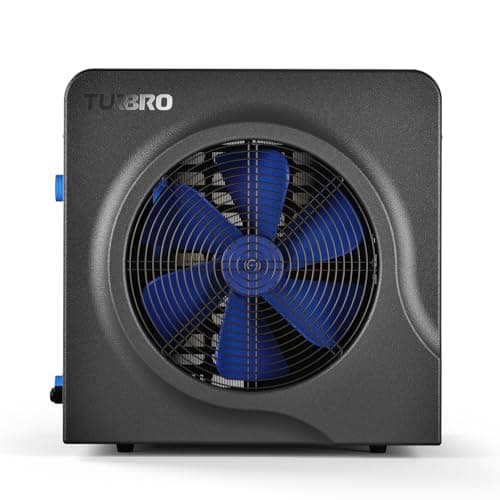 Best small and cheap TURBRO Manatee M18 18,000 BTU Above-Ground Pool Heat Pump Titanium exchanger on a plug-in 18,000 BTU unit, which is unusual at the price. | An above-ground pool up to about 6,000 gallons, with no 240V circuit available | |
| — |  The one to avoid on salt Raypak 206,000 BTU Digital Propane Pool Heater All copper fin-tube. A fine heater, and the wrong metal for salt water. | A propane pool that wants a faster heat-up than a 150,000 BTU heater gives | |
| 5 |  Neutral to salt, and buy it anyway Sun2Solar 1600 Series Ultimate Blue Solar Cover Polyethylene does not corrode. The cheapest heat on a salt pool is the heat you do not lose. | An inground pool you cover most nights, every season |
#ad We earn a commission if you buy through this link, at no extra cost to you. It never changes the ranking. How this site is funded. Prices last checked October 17, 2026.
What salt actually does to a heater
A saltwater pool is not a heavily salted one — a chlorine generator runs at roughly 3,000 parts per million, about a tenth of seawater, which is why it tastes faintly of nothing. That concentration is still enough to accelerate galvanic corrosion in the one component where corrosion is expensive: the heat exchanger, where pool water passes within a fraction of a millimeter of the heat source.
Three materials are used, and they are not interchangeable.
| Material | Where you find it | On a salt pool |
|---|---|---|
| Copper fin-tube | Most gas and propane heaters, including good ones | The wrong choice. Copper is the standard material because it transfers heat superbly and costs least, not because it resists salt. |
| Cupro-nickel | The upgrade option on many gas heaters, usually a few hundred dollars more | Workable. Sold specifically for salt and for aggressive water chemistry, and the usual answer if you want a gas heater on a salt pool. |
| Titanium | Standard on most pool heat pumps, rare on gas heaters | The right answer. Effectively inert in pool water, which is why the heat pump category standardized on it. |
This is the one specification to read before price, brand or BTU. Everything else on a heater can be serviced; a corroded exchanger is usually the end of the machine.
What each maker will actually put in writing
This is where the category separates. We read the current listing for every heater on this site and recorded the exact claim.
| Heater | Stated exchanger | Saltwater stated explicitly? |
|---|---|---|
| Hayward HeatPro (W3HP21405T) | Titanium | Yes — 'compatibility with a wide range of pool water conditions, including saltwater pools' |
| Hayward HeatPro (W3HP21404T) | Titanium | Yes — 'excellent salt water and chemical corrosion resistance', plus Ultra Gold coating for coastal air |
| AquaCal SuperQuiet SQ160R | ThermoLink titanium | Not in those words on the listing, though titanium is stated |
| TURBRO Manatee M18 and Beluga B33V | Titanium | Yes — 'resisting corrosion to be compatible with saltwater pools' |
| FibroPool FH255 | Not stated on the listing | No |
| Raypak PR206AEPC propane | All copper fin-tube with a stainless tube sheet | No — and copper is the material to avoid |
An unstated exchanger material is not the same as a bad one, but on a salt pool it is a question to settle with the manufacturer before the heater ships rather than after.
If you want a gas heater on a salt pool
You can have one — you need the cupro-nickel version. Most gas heater families sell the same model in copper and cupro-nickel, the cupro-nickel costs a few hundred dollars more, and the part number differs by a character or two. That last detail is the trap: the listings are near-identical, and the difference between the right heater and the wrong one is buried in a model string.
Two rules that cost nothing. Read the model number on the listing against the manufacturer’s own model list, and if the listing does not say cupro-nickel anywhere, assume copper. A heater sold as “corrosion resistant” with no material named is describing its cabinet.
The rest of the heater also lives outdoors
Salt does not stay in the water. Chlorine generators produce a fine salt aerosol around the pool, and in coastal air there is more of it. Hayward’s older HeatPro listing is unusually explicit about this, naming an “Ultra Gold corrosion-resistant” finish and UV-resistant body panels for coastal environments — the cabinet and the fasteners, not the exchanger.
That is worth a little attention when siting the unit. Downwind of the pool and hard against a fence is the worst place for anything metal.
What salt does not change
- Sizing. A salt pool needs exactly as many BTU as a chlorine pool of the same volume. Use the BTU calculator the same way.
- Running cost. Identical. The cost arithmetic does not know what your chlorine comes from.
- Covers. Polyethylene bubble film is indifferent to salt, so every cover on this site is fine. Aluminum reel frames are not indifferent to salt spray, which is a reason to prefer a reel cover if the reel lives by the water.
Every pick, in detail
What each one publishes, what is good and bad about it, and — the section this category usually omits — what we could not judge without owning one.
Hayward HeatPro Pool Heat Pump
If you are heating a pool with electricity, this is the shape of machine to do it with. A heat pump moves heat instead of making it, and at the assumptions we publish it delivers a million BTU into the water for about a fifth of what an electric resistance heater costs to deliver the same. It is slower than gas and it fades as the air gets colder, which is exactly when you want it — that trade is the whole decision.
Best for Lowest running cost per degree when you want real temperature control
| Type | Air-source heat pumpThe manufacturer publishes no retrievable specification sheet; figure is as listed at retail. | Retail listing |
|---|---|---|
| Rating convention | Rated by BTU/hr OUTPUTThis is the trap in the category. Gas heaters are rated by fuel INPUT, heat pumps by heat OUTPUT. A 140,000 BTU heat pump and a 140,000 BTU gas heater do not deliver the same heat. | Published standard |
| Cost per million BTU delivered | About $10.75 at our published assumptionsUS average residential electricity at 18.34 cents/kWh (EIA, June 2026) and an assumed COP of 5.0. Both are substitutable on our running-cost calculator. | Our arithmetic |
- Cheapest running cost per delivered BTU of any controllable heater
- No gas line, no combustion, no flue
- Holds a set temperature rather than depending on the weather
- Slow — expect most of a day to move a full-size pool ten degrees
- Efficiency falls with air temperature, so it is weakest in the shoulder season
- High purchase price against a gas heater of comparable output
- The COP this specific unit achieves at your conditions
- Compressor and control-board longevity
- Noise at the distance your deck actually sits from it
These need a unit in hand across a season. We do not have one, so we do not have an opinion worth printing on them.
#ad We earn a commission if you buy through this link, at no extra cost to you. It never changes the ranking. How this site is funded. Prices last checked October 17, 2026.
AquaCal HeatWave SuperQuiet SQ160R Pool Heat Pump
The heat pump for a buyer who wants a titanium heat exchanger, app control and a long exchanger warranty, and is willing to pay more per BTU to get them. At 128,000 BTU/hr it delivers less heat than the Hayward and Raypak units this site already ranks, and it is not the cheaper of the three, so it does not win on heat per dollar. What it does have is the one number the category usually hides: a published COP, at a stated test condition.
Best for A full-size pool where the titanium exchanger, app control and warranty are worth paying for
| Rated output | 128,000 BTU/hrHeat-pump convention: OUTPUT into the water. Not comparable with a gas heater's input rating. | Retail listing |
|---|---|---|
| Published COP | 5.7 at 80°F air / 80°F water / 80% humidityThe conditions are the point. That is the AHRI standard rating, and 80°F air is a summer afternoon — a heat pump's COP falls as the air cools, so this figure says very little about the shoulder season most people buy one for. AquaCal's own technical packet publishes no COP at all. | Retail listing |
| Heat exchanger | ThermoLink titaniumTitanium is the corrosion-resistant option and matters most on salt pools. | Retail listing |
| Water flow required | 30 to 70 GPMA real constraint at both ends: some single-speed pumps push more than 70 GPM, and a variable-speed pump run low for filtration can fall under 30. | Retail listing |
| Electrical | 208-230V single phase, 43.3 minimum circuit ampacityA dedicated circuit sized by an electrician, not a spare breaker. | Retail listing |
| Control | Digital panel with PoolSync WiFi | Retail listing |
| Cost per million BTU delivered | About $9.43 at the published COP of 5.7US average residential electricity at 18.34 cents/kWh (EIA, June 2026) divided by 5.7. At the more conservative COP of 5.0 we assume across the site it is about $10.75 — and at real shoulder-season air temperatures it will be worse than either. | Our arithmetic |
- Publishes a COP and the conditions it was measured at, which most of this category does not
- Titanium heat exchanger and a corrosion-resistant cabinet
- PoolSync WiFi control is included rather than an add-on
- Fewer BTU per hour than the Hayward HeatPro and Raypak 8450, at a higher price than the Raypak
- About 13 hours to lift 20,000 gallons ten degrees — slower than both of those
- Retail pages disagree on the warranty term, and on whether this model cools as well as heats
- The COP it reaches at 50°F air, which is the number that would actually decide a shoulder-season purchase
- Compressor and control-board life
- Noise, despite the SuperQuiet name — no decibel figure is published
These need a unit in hand across a season. We do not have one, so we do not have an opinion worth printing on them.
#ad We earn a commission if you buy through this link, at no extra cost to you. It never changes the ranking. How this site is funded. Prices last checked October 17, 2026.
TURBRO Manatee M18 18,000 BTU Above-Ground Pool Heat Pump
The plug-in heat pump, and the honest version of that category. It runs on a normal 110-120V GFCI outlet, carries a titanium exchanger, and TURBRO states a COP of 5.5 — in the same range the established brands publish rather than the impossible numbers import listings often print. It is also the only listing we read that tells you the truth about speed: TURBRO's own note says reaching your target temperature 'may take a few days rather than immediate results'. Believe that note.
Best for An above-ground pool up to about 6,000 gallons, with no 240V circuit available
| Rated output | 18,000 BTU/hrHeat pumps rate by output. 18,000 BTU/hr is about an eighth of a full-size unit. | Manufacturer |
|---|---|---|
| Stated COP | 5.5No test condition is published with it. Read it as a warm-air best case, as with every COP in this category. | Manufacturer |
| Supply | 110-120V, GFCI plug, IPX4The whole point of the unit. No electrician, no dedicated 240V circuit. | Manufacturer |
| Heat exchanger | Titanium | Manufacturer |
| Pool size the maker names | Up to 6,000 gallons — round pools to 16 ft, rectangular to 12 x 20 ft | Manufacturer |
| Operating range | Heats to 59-104°F in ambient air from 41-109.4°F; also cools | Manufacturer |
| Warranty | 2-year full machine | Manufacturer |
| Time to lift 6,000 gallons ten degrees | About 28 hours of run time6,000 x 8.33 x 10 = 499,800 BTU, divided by 18,000 BTU/hr. Ignores the heat the pool loses while heating, so the real figure is longer — which is what TURBRO's 'a few days' note is telling you. | Our arithmetic |
- Plugs into a standard outlet — no electrician, which can be the larger cost on a small pool
- Titanium exchanger at this price, so a salt pool is not ruled out
- The listing states the slow heat-up rather than hiding it
- 18,000 BTU/hr means days, not hours, to reach temperature from cold
- Almost useless without a cover — it cannot outrun overnight evaporation loss
- TURBRO is an import brand with no long service record we could check
- Compressor life, which is the whole question on a budget heat pump
- The COP it actually reaches at 60°F air
- Parts and warranty support in three years' time
These need a unit in hand across a season. We do not have one, so we do not have an opinion worth printing on them.
#ad We earn a commission if you buy through this link, at no extra cost to you. It never changes the ranking. How this site is funded. Prices last checked October 17, 2026.
Raypak 206,000 BTU Digital Propane Pool Heater
More burner than the Hayward 150 for a comparable outlay, and the reason to consider it is the heat exchanger rather than the BTU. Raypak states copper fin-tube with a stainless steel tube sheet and polymer headers, which is more construction detail than most of this category publishes. On a propane pool the higher rating is a double-edged specification: it heats faster and it empties the tank faster.
Best for A propane pool that wants a faster heat-up than a 150,000 BTU heater gives
| Rated input | 206,000 BTU/hrInput, as the whole gas category rates. About 169,000 BTU/hr delivered at 82%. | Manufacturer |
|---|---|---|
| Heat exchanger | All copper fin-tube with a stainless steel tube sheetCopper transfers heat well and is the standard choice. It is also the wrong choice on a salt pool — see our page on heaters for saltwater pools. | Manufacturer |
| Headers | Polymer | Manufacturer |
| Controls | Microprocessor-controlled thermostat, electronic ignition | Manufacturer |
| Water connections | 2 in CPVC | Manufacturer |
| Cabinet | PolyTuf powder-coated, described as non-corrosive and rust resistant | Manufacturer |
| Weight | 187 lb | Retail listing |
| Propane use at full rate | About 2.25 gallons per hour206,000 BTU/hr divided by 91,452 BTU per gallon of propane (EIA). At $2.674/gal that is roughly $6.02 an hour of burner time. | Our arithmetic |
- Publishes real construction detail — exchanger, tube sheet, headers — which most of the category does not
- 206,000 BTU/hr heats a mid-size pool in a single morning
- Digital thermostat rather than a dial
- Copper fin-tube is the wrong exchanger for a salt pool
- About 2.25 gallons of propane an hour at full rate — a 100 lb cylinder is roughly ten hours
- No published thermal efficiency figure on the listing
- Real-world thermal efficiency, which Raypak does not state here
- Burner and control board life
- Whether your propane supply can hold pressure at this draw in cold weather
These need a unit in hand across a season. We do not have one, so we do not have an opinion worth printing on them.
#ad We earn a commission if you buy through this link, at no extra cost to you. It never changes the ranking. How this site is funded. Prices last checked October 17, 2026.
Sun2Solar 1600 Series Ultimate Blue Solar Cover
The cover to buy if you intend to keep using it in five years. 16 mil is the thickest tier the category sells, and thickness on a solar cover buys durability rather than heat — Bob Vila measured every cover in its hands-on group at the same 4 to 5 degrees, from 12-mil clear to 16-mil blue. Pay the extra for the one that survives being dragged over the coping twice a day, not for a temperature difference that did not show up in the only published one-hour test in this category.
Best for An inground pool you cover most nights, every season
| Price shown for | 24 ft roundThis product is sold in several sizes on one listing. The live price and photograph on this page are the ones Amazon returns for this variant; other sizes are priced separately. | Retail listing |
|---|---|---|
| Thickness | 16 milThe manufacturer publishes no retrievable specification sheet; figure is as listed at retail. | Retail listing |
| Color | Blue | Retail listing |
| Stated lifespan | 5 to 10 years for the 16-mil tierSwim University's published figure for 16-mil covers generally, not a Sun2Solar warranty statement. | Retail listing |
| Bubble side | Bubbles face the waterCategory-wide instruction, not brand-specific. The bubbles are the insulating layer and they have to touch the water. | Published standard |
4 to 5 degrees F in one hour
Claimed by Bob Vila, measured across all covers in their group. Conditions: One hour under 2pm sun on 89 to 92 degree F days. Source
Their figure was the same for every cover they put on the water. Read our reconciliation of what a one-hour reading actually measures before you plan around this number.
- Thickest tier sold, which is where the durability difference actually is
- Blue absorbs more of the incoming energy at the surface than clear does
- Cuts oversize to your pool shape with household scissors
- Heavy and awkward at 16 mil — a large inground cover is genuinely a two-person job without a reel
- Costs meaningfully more than the 12-mil version for no measured heating advantage
- Whether the seams hold up over five seasons of daily handling
- How the bubble layer survives repeated dragging over rough coping
- Whether the stated lifespan tier holds for this specific product line
These need a unit in hand across a season. We do not have one, so we do not have an opinion worth printing on them.
#ad We earn a commission if you buy through this link, at no extra cost to you. It never changes the ranking. How this site is funded. Prices last checked October 17, 2026.
Questions people actually ask
Do I need a special pool heater for a saltwater pool?
Is titanium or cupro-nickel better for a salt pool?
Will a salt pool void my heater warranty?
Does a saltwater pool cost more to heat?
- Hayward W3HP21405T HeatPro listing: 140,000 BTU, titanium heat exchanger, 230V, 33.6 x 30.5 x 44 in, 250 lb, stated as compatible with saltwater poolsHayward, as listed at retail · read 2026-09-20
- Hayward W3HP21404T HeatPro listing: same 140,000 BTU rating, Ultra Gold corrosion-resistant finish, tan cabinet, 40 x 31.5 x 50 in, 320 lbHayward, as listed at retail · read 2026-09-20
- AquaCal HeatWave SuperQuiet SQ160R listing: 128,000 BTU, 230V single phase 60 Hz, R410A, digital controls, corrosion-resistant cabinet, dual water connectionsAquaCal, as listed at retail · read 2026-09-19
- TURBRO Manatee M18 listing: 18,000 BTU, stated COP 5.5, titanium heat exchanger, 110-120V GFCI plug, rated for pools to 6,000 gallons, 2-year machine warranty, and the maker's own note that reaching target temperature 'may take a few days rather than immediate results'TURBRO, as listed at retail · read 2026-09-20
- TURBRO Beluga B33V listing: 33,000 BTU full DC inverter, titanium heat exchanger, WiFi, rated for pools to 10,000 gallons, 2-year machine / 5-year compressor warranty, claimed 'COP rating up to 15.8 (AHRI Standard 1160(I-P))', and explicitly not recommended for inflatable poolsTURBRO, as listed at retail · read 2026-09-20
- Raypak PR206AEPC listing: 206,000 BTU propane, microprocessor thermostat, copper fin-tube heat exchanger, stainless steel tube sheet, polymer headers, 2 in CPVC connections, 187 lbRaypak, as listed at retail · read 2026-09-20
#ad Where a retailer’s listing is cited above as the source of a published specification, that link is an affiliate link, at no extra cost to you. Independent sources and manufacturer documentation are never wrapped and earn nothing. How this site is funded.
Every URL above was fetched and returned content on the date shown. Where a figure is ours rather than somebody else’s, the arithmetic is on the page and on the methodology page. If you find an error in it, we would genuinely like to know.
Read next

Replacing a pool heater
What carries over from the old heater and what does not, why matching the old BTU is usually wrong, and why a replacement is the one affordable moment to switch fuel.
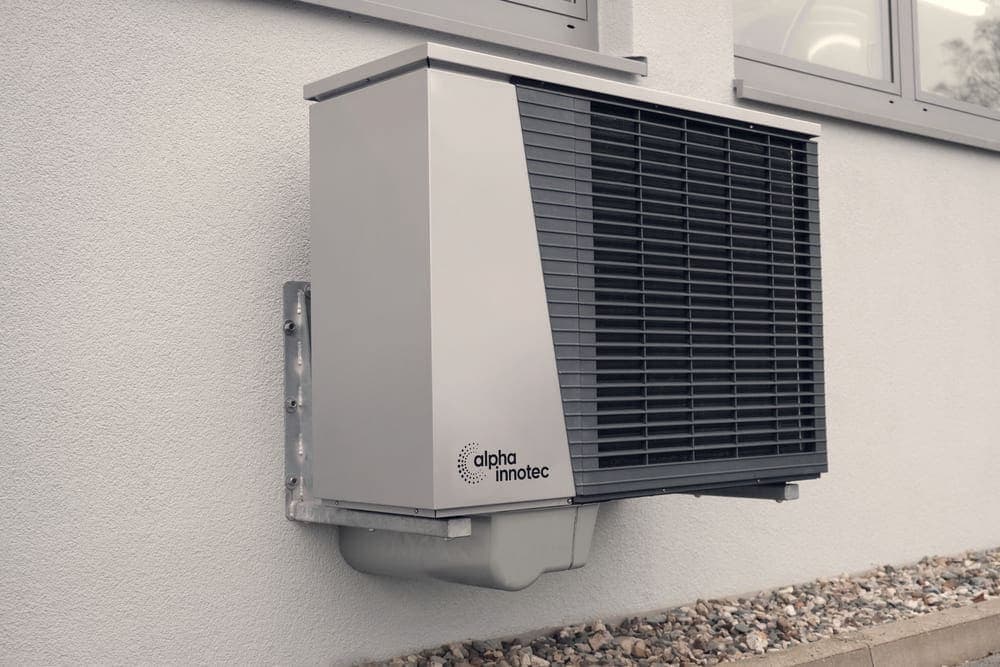
Pool heat pumps worth buying
Full-size and small heat pumps ranked on published output, exchanger material and what the manufacturer will actually say about efficiency. With the sizing math for your pool.
AquaCal HeatWave SuperQuiet review
AquaCal's SuperQuiet line on the record: a published COP of 5.7 at a summer test condition, a titanium exchanger, a narrow flow window, and less heat per hour than the two full-size rivals this site already ranks.
Heat pump vs gas pool heater
The two options priced per delivered BTU and timed on the same pool, with the one question that decides which trade suits you.
Heat pumps for above-ground pools
18,000 to 55,000 BTU heat pumps for above-ground pools, including 110V plug-in units. Ranked on published output and warranty, with the hours-to-temperature arithmetic.
Pool heater brands, compared
Hayward, Pentair, Raypak, Jandy, AquaCal and FibroPool at brand level: what each builds, what each publishes, and which to shortlist.