How fast a pool loses heat
Four escape routes, one of them enormous. Two thermometer readings tell you more about your pool than any published figure.
Quick picks
Everything here addresses evaporation, because that is where the loss is.
| # | Product | Best for | Price |
|---|---|---|---|
| 1 | 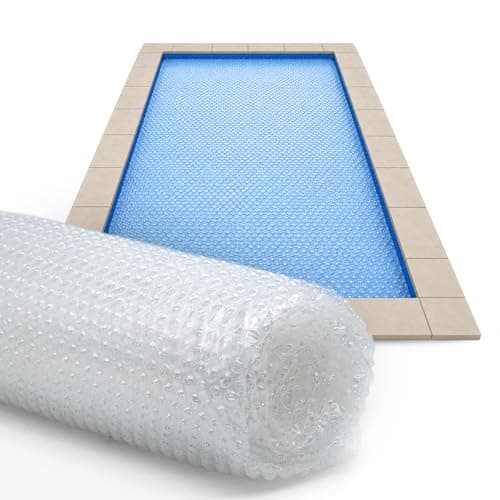 Attacks the biggest loss Sun2Solar 1200 Series Crystal Clear Solar Cover About 70% of the loss is evaporation, and a cover is the only cheap thing that stops it. | Most pools, most budgets — the default recommendation | |
| 2 | No photo Makes it happen nightly Blue Wave Solar Cover Reel A cover only defends the nights it is actually on. | Any inground pool with a cover you are not using enough | |
| 3 | No photo When no blanket fits HeatSavr Liquid Solar Cover Same mechanism, far less effective, no handling at all. | Odd-shaped pools and anyone who will never use a blanket |
#ad We earn a commission if you buy through this link, at no extra cost to you. It never changes the ranking. How this site is funded. Prices last checked October 18, 2026.
Four ways out
A swimming pool is a large, uninsulated, open-topped tank of warm water sitting outdoors. It loses heat continuously by four routes, and they are nothing like equal.
| Route | What it is | Share |
|---|---|---|
| Evaporation | Water molecules leaving the surface, carrying their latent heat with them | About 70% (DOE) |
| Radiation | Infrared radiated from the surface, worst on clear nights | The bulk of the remainder |
| Convection | Heat carried away by air moving over the surface | Rises sharply with wind |
| Conduction | Heat into the ground through the shell | Small, and you cannot do anything about it |
DOE publishes the evaporation share. The others are the balance and are not individually quantified in the source, so we do not put numbers on them.
That 70% figure is the most useful number in this whole subject, because it means one mechanism dominates and one intervention addresses it.
Why evaporation costs so much
Water carries an enormous amount of energy when it changes phase. DOE’s published figure is 1,048 BTU per pound of 80°F water evaporated.
| 1 gallon of pool water | about 8.33 lb |
| x 1,048 BTU per lb (DOE) |
8,730 BTU per gallon evaporated
For comparison, raising that same gallon by one degree takes 8.33 BTU. Evaporating it takes over a thousand times as much energy as warming it by a degree. That asymmetry is why a lid beats a heater.
What a night actually costs you
| 20,000 x 8.33 x 3 | = 499,800 BTU lost |
| x 70% evaporation share | = 349,860 BTU |
| ÷ 8,730 BTU per gallon evaporated | = about 40 gallons of water |
| 40 gal over a 512 sq ft pool | = about 0.126 inches |
An eighth of an inch off the surface, and about half a million BTU gone
That depth figure is a useful sanity check on the whole model: an eighth of an inch overnight, plus daytime evaporation, lands close to the quarter-inch-per-day that pool owners commonly report. Two independent routes agreeing is a good sign the arithmetic is right.
| Fuel | Per night | Per 30 nights | Per 150-night season |
|---|---|---|---|
| Heat pump | $3.76 | $112.83 | $564.16 |
| Natural gas | $9.92 | $297.63 | $1,488.16 |
| Propane | $12.48 | $374.26 | $1,871.28 |
| Electric resistance | $18.81 | $564.16 | $2,820.82 |
The evaporation share only — the part a cover can address. This is the number a hundred-dollar cover is defending.
Wind is the multiplier nobody mentions
DOE publishes that a 7 mph wind across the pool surface can increase energy consumption by 300% — four times the still-air rate.
Seven miles an hour is a light breeze. A flag stirring. Leaves moving. That is not a storm, it is a normal evening in most of the country, and it is quadrupling your heat loss.
Which makes a windbreak one of the most cost-effective interventions available and one almost nobody makes. A hedge, a fence, a lattice screen on the prevailing side does more thermal work than most equipment upgrades. More free interventions.
Measure your own pool — it takes two readings
Every published average is a poor substitute for your own measurement, and yours is easy to get.
- Read at dusk. A foot down, away from the return jets. Note the time.
- Read at dawn, before the sun has been on the water. Same depth, same spot.
- The difference is your overnight loss.
Take it on a still, clear night for the worst case, and do it once uncovered and once covered — that gives you your own measurement of what a cover does for your pool, which is worth more than any figure we or anyone else can publish.
Once you have the number, turn it into dollars.
What actually reduces the loss
- A cover. Addresses the 70%. DOE puts the saving from covering a pool when not in use at 50 to 70% of heating cost.
- A windbreak. Addresses the 300% multiplier. Free to cheap.
- A lower setpoint. A cooler pool leaks more slowly, and DOE puts each degree at 10 to 30% of the bill.
- Pump timing. Circulate during the warm part of the day rather than through the coldest hours.
Notice that none of those is a heater. Reducing the loss is consistently cheaper than increasing the supply, and it keeps being cheaper every night for years.
Every pick, in detail
What each one publishes, what is good and bad about it, and — the section this category usually omits — what we could not judge without owning one.
Sun2Solar 1200 Series Crystal Clear Solar Cover
The value pick, and the one whose logic actually holds up. A clear cover transmits more sunlight into the body of the pool instead of absorbing it at the surface, and 12 mil is the point where lifespan stops being the limiting factor. Bob Vila measured this and the 16-mil blue at the same 4 to 5 degrees in an hour, so you are paying less for the same measured result and giving up some years of service life.
Best for Most pools, most budgets — the default recommendation
| Price shown for | 20 x 40 ft rectangleThis product is sold in several sizes on one listing. The live price and photograph on this page are the ones Amazon returns for this variant; other sizes are priced separately. | Retail listing |
|---|---|---|
| Thickness | 12 milThe manufacturer publishes no retrievable specification sheet; figure is as listed at retail. | Retail listing |
| Color | Clear | Retail listing |
| Stated lifespan | 3 to 4 years for the 12-mil clear tierSwim University's published figure for 12-mil clear covers generally. | Retail listing |
| Bubble side | Bubbles face the water | Published standard |
4 to 5 degrees F in one hour
Claimed by Bob Vila, measured across all covers in their group. Conditions: One hour under 2pm sun on 89 to 92 degree F days. Source
- Clear transmits more light into the water instead of stopping it at the surface
- 12 mil is the sweet spot: real service life without 16-mil bulk
- Cheaper than the 16-mil tier with no measured heating penalty
- Shorter published lifespan tier than 16 mil
- A clear cover shows algae and debris more obviously, which some people dislike
- Whether clear genuinely outlasts or under-lasts blue in the same thickness
- Real-world tear resistance at a pool with rough edges
- How much the clear material clouds over a season of UV
These need a unit in hand across a season. We do not have one, so we do not have an opinion worth printing on them.
#ad We earn a commission if you buy through this link, at no extra cost to you. It never changes the ranking. How this site is funded. Prices last checked October 18, 2026.
Blue Wave Solar Cover Reel
A reel is the single highest-leverage purchase in this whole category and almost nobody frames it that way. Every DOE saving figure assumes the cover is on the pool when the pool is not in use. A cover that takes two people and five minutes comes off on Friday and goes back on in October. A reel turns that into thirty seconds alone, which is the difference between the savings existing and not.
Best for Any inground pool with a cover you are not using enough
| Type | Wheeled above-ground-style reel for inground and above-ground useThe manufacturer publishes no retrievable specification sheet; figure is as listed at retail. | Retail listing |
|---|---|---|
| Why it matters | Converts a two-person five-minute job into a one-person thirty-second jobOur framing, not a manufacturer claim. The published savings all assume the cover is actually on. | Our arithmetic |
- Turns the cover into something you will genuinely use daily
- Keeps the cover off the ground, which is where covers get damaged
- Wheels, so it moves out of the way
- Costs a real fraction of what the cover itself costs
- Takes up deck space permanently
- Assembly is fiddly on every reel in this category
- How the tube and hardware hold up outdoors across seasons
- Whether the width range covers your pool without a wobble
- Assembly quality and hardware fit
These need a unit in hand across a season. We do not have one, so we do not have an opinion worth printing on them.
#ad We earn a commission if you buy through this link, at no extra cost to you. It never changes the ranking. How this site is funded. Prices last checked October 18, 2026.
HeatSavr Liquid Solar Cover
A monolayer chemical that spreads a molecule-thick film across the surface to slow evaporation. It is the only option here that does not require you to physically cover anything, which is exactly why people buy it — and it is also the reason to be careful with the claims: a film that thin is disrupted by swimmers, wind and the return jets, and it is doing nothing for the hours after that until it re-spreads.
Best for Odd-shaped pools and anyone who will never use a blanket
| How it works | Self-spreading monolayer that slows surface evaporation | Published standard |
|---|---|---|
| Typical price | About $10 to $30 or moreSwim University's published range for liquid covers generally, read 2026-09-02. | Retail listing |
| Effect on daytime gain | None to speak ofA monolayer is optically negligible. Any benefit is on the evaporation side, which is the overnight-retention mechanism, not daytime gain. | Our arithmetic |
- Works on any pool shape, including the ones no blanket fits
- Nothing to store, fold, drag or trip over
- Cheap enough to try
- Disrupted by swimming, wind and circulation, and takes time to re-form
- Nothing published that would let you quantify what it actually saves
- Does not warm the pool during the day the way a physical cover can
- How much evaporation it actually suppresses on a real pool
- How quickly the film re-forms after use
- Whether dosing frequency in practice matches the label
These need a unit in hand across a season. We do not have one, so we do not have an opinion worth printing on them.
#ad We earn a commission if you buy through this link, at no extra cost to you. It never changes the ranking. How this site is funded. Prices last checked October 18, 2026.
Questions people actually ask
How much heat does a pool lose overnight?
Why does my pool lose so much heat at night?
How much water does a pool lose to evaporation?
Does wind really make that much difference?
- Average retail price of electricity to US residential customers: 18.34 cents/kWh, June 2026U.S. Energy Information Administration · read 2026-09-02
- US residential natural gas price: $24.09 per thousand cubic feet, June 2026U.S. Energy Information Administration · read 2026-09-02
- US residential propane price: $2.674 per gallon, week ending 30 March 2026U.S. Energy Information Administration · read 2026-09-02
- Energy content conversion factors: 3,412 BTU per kWh, 1,036 BTU per cubic foot of natural gas, 91,452 BTU per gallon of propaneU.S. Energy Information Administration · read 2026-09-02
- U.S. Department of Energy pool-energy figures (evaporation share, BTU per pound evaporated, cover savings, recommended temperatures, wind effect)Recreonics, reproducing and attributing the U.S. Department of Energy · read 2026-09-02
- Pool heater roundup: the 8.33 BTU per gallon per °F figure, attributed on the page to Alicia Toedter of Leslie'sBob Vila · read 2026-09-02
Every URL above was fetched and returned content on the date shown. Where a figure is ours rather than somebody else’s, the arithmetic is on the page and on the methodology page. If you find an error in it, we would genuinely like to know.
Read next
Pool domes and enclosures
Domes and enclosures for above-ground pools, ranked on shell transparency and on whether the maker publishes a fitment spec you can measure against. With the DOE wind figure behind the whole idea.
Pool thermometers worth buying
Wireless, analog and WiFi-logging pool thermometers ranked on whether you will actually take the dusk-and-dawn reading, what each maker publishes, and the surface-reading limit every float shares.
How to keep a pool warm
Four loss paths take heat out of a pool and they are not equal. What addresses each one, ranked by effect per dollar, and the operating choices that matter more than equipment.
Keeping a pool warm overnight
The specific problem of overnight heat loss: what causes it, what each fix is worth, and the order to try them in.
Does a solar cover pay for itself?
The full payback derivation from one measurement you can take tonight, plus a sensitivity table for people whose pool is nothing like the example.
Do solar pool covers work?
The 4-degrees-versus-15-degrees contradiction that runs through this entire category, reconciled from published physics. Three different quantities being reported as one.
Solar pool covers worth buying
Ranked on the specifications that actually differ between covers — thickness tier and published lifespan — because the only hands-on test in this category found no heating difference at all.
The ideal pool temperature
DOE's recommended ranges for swimming and for lounging, why they differ, and the 10-to-30%-per-degree figure that makes the setpoint the biggest lever you own.
How much does it cost to heat a pool?
The complete cost model: what a million BTU costs to deliver with each fuel, what that means per degree and per pool size, and why heat-up cost is not your monthly bill.