Cover Free liquid solar blanket review
The manufacturer publishes a dose rate and no percentages. The retail listings publish two percentages that cannot both be true. Here is what that leaves.
Quick picks
The product, its direct competitor, and the physical cover that outperforms both — because the honest ranking here puts a blanket first for any pool that can take one.
| # | Product | Best for | Price |
|---|---|---|---|
| 1 | 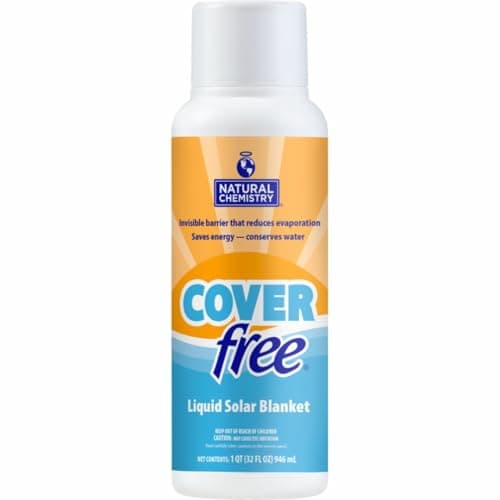 The one being reviewed Cover Free Liquid Solar Blanket A stearyl-alcohol monolayer with a published dose rate: 4 oz per 675 sq ft, weekly. | The same job as HeatSavr, when it is cheaper on the day | |
| 2 | No photo The alternative in the same category HeatSavr Liquid Solar Cover Same mechanism, the other name people search. Sold as a liquid and as an automated dispenser. | Odd-shaped pools and anyone who will never use a blanket | |
| 3 | 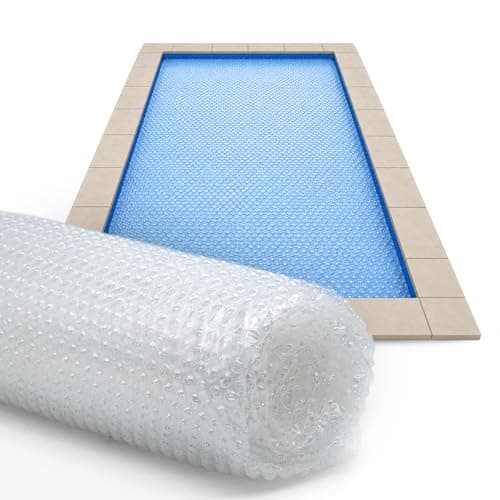 What actually does more Sun2Solar 1200 Series Crystal Clear Solar Cover A physical cover does the daytime job a monolayer cannot, and it does the overnight job better. | Most pools, most budgets — the default recommendation |
#ad We earn a commission if you buy through this link, at no extra cost to you. It never changes the ranking. How this site is funded. Prices last checked October 18, 2026.
What Natural Chemistry publishes
Coverfree is Natural Chemistry’s liquid solar blanket, and it is the product most people mean when they search for “Cover Free”. Reading the manufacturer’s own product page on 13 September 2026, here is everything it states:
- Dose: “Weekly with circulation system running, add 4 oz. per 675 sq. ft. (20,000 gallons)” of surface area.
- Twice weekly in drought-affected regions.
- Reapply after heavy bather activity or significant rainfall.
- Skimmer application preferred, though it can go straight into the water.
- “Safe to use with all sanitizing systems.”
- Sold as 946 ml / 32 oz, SKU 17100NCM.
The Amazon listing adds “Advanced Mono-Layer Technology, pH Neutral Formula”, and the ingredients that circulate for this product are stearyl alcohol and propylene glycol — stearyl alcohol being the long-chain alcohol that does the actual work.
What the manufacturer page does not state is any percentage at all. No evaporation figure, no heat-loss figure, no temperature claim. That absence turns out to matter.
The two retail claims, and why they disagree
Retail listings for the same product carry numbers the manufacturer does not: that it reduces water evaporation by up to 85% and reduces heat loss by as much as 70%. Put those beside the Department of Energy’s figure for where a pool’s heat goes and they do not fit together.
| DOE: evaporation is about 70% of total heat loss | |
| Claim: evaporation cut by 85% | |
| So total heat loss falls by 0.85 x 70% | = 59.5% |
| But the same listing claims heat loss cut by | 70% |
A 70% cut in total heat loss would need evaporation stopped essentially completely
The two numbers are printed side by side on the same listings and they cannot both be right. An 85% evaporation reduction is worth about a 59% cut in total heat loss, not 70%. We are not saying either figure is false — we are saying they were not derived from the same model, and neither is sourced.
This is the pattern worth carrying away from the page, and it is not unique to this brand: the manufacturer states a modest, specific, operational fact, and the numbers get larger the further you travel from it. We found the same thing when we looked at Intex’s solar covers, where the manufacturer claims 95% evaporation reduction and no temperature gain, while retail listings add a 5-to-15-degree range Intex never published.
The dose arithmetic, which nobody works out
The dose rate is the most useful thing Natural Chemistry publishes, because it converts directly into how much product your pool consumes. Four ounces per 675 square feet of surface area, weekly, and a quart is 32 ounces — eight full doses.
| 18 ft round (254 sq ft): 254 ÷ 675 x 4 oz | = 1.5 oz/week → about 21 weeks |
| 16 x 32 ft (512 sq ft): 512 ÷ 675 x 4 oz | = 3.0 oz/week → about 10 weeks |
| 20 x 40 ft (800 sq ft): 800 ÷ 675 x 4 oz | = 4.7 oz/week → about 7 weeks |
Surface area, not volume — the dose is per square foot of water in contact with the air, which is the right basis for an evaporation product. These are full-dose figures before any reapplication after rain or a busy weekend.
Run that across a season and the picture sharpens. A 150-night season is roughly 21 weeks, so a 16 by 32 pool works through about two quarts and a 20 by 40 pool about three — before the reapplications the manufacturer asks for after heavy bather use or significant rain.
That is the number to hold when you compare this against a physical cover. A blanket is bought once and lasts years by published lifespan tier; a liquid cover is a consumable you buy every season, forever. We do not print prices in article copy, but the buy buttons on this page show what each currently costs, and the comparison to make is season-after-season, not sticker against sticker.
What the dose rate quietly tells you
Two things, and both are more informative than the percentages.
Weekly dosing means the film is consumed. A monolayer does not sit there indefinitely. It degrades, it gets skimmed off, it leaves with splash-out and backwash. A product that needed topping up monthly would be making a different claim about its own persistence than one that needs topping up weekly.
Reapplication after bathers and rain is the disruption problem, stated by the manufacturer. We wrote on the liquid cover page that swimmers, wind and return jets break a monolayer up, and that the film re-forms but takes time. Natural Chemistry’s own instruction to re-dose after heavy bather activity is the same fact from the other side, and it is to their credit that they say it.
Cover Free against HeatSavr
These are the two names in this category and the honest summary is that nothing published separates them on performance. Both are self-spreading long-chain alcohol monolayers. Neither has a retrievable independent measurement behind it. The differences that do exist are practical:
| Cover Free (Natural Chemistry) | HeatSavr | |
|---|---|---|
| Published dose rate | 4 oz per 675 sq ft, weekly | Stated per product size |
| Manufacturer percentage claim | None on its own page | None we could retrieve |
| Retail percentage claims | Up to 85% evaporation, 70% heat loss | Varies by listing |
| Automated dispenser sold | Not for this line | Yes, as a separate kit |
| Application | Skimmer preferred, or straight in | Skimmer or dispenser |
Read as what each company chooses to publish, not as a performance comparison — there is no published test that would support one. The dispenser is the real functional difference: it removes the weekly step, which on this kind of product is the step that gets forgotten.
If the weekly dose is the thing you are going to forget — and on a product whose entire value depends on being topped up, that is the failure mode — the automated dispenser route is worth the look, and it is HeatSavr that sells one. If you will remember, or you already run a weekly chemical routine you can bolt this onto, the two are interchangeable and price on the day decides it.
Who should buy it
- Freeform pools, grottos, hardscape in the water. No blanket fits these. A liquid does not care about shape, and this is the strongest case for the category.
- Pools where the blanket stopped going on. A liquid cover that is dosed is worth more than a blanket in the shed. This is a behavioral argument rather than a physical one, and it is real.
- Alongside a blanket, on a pool in daily use. The monolayer covers the hours the blanket is off. They do not conflict.
- Indoor pools, where evaporation is the dominant problem and a blanket is awkward.
Who should not
- Anyone who could simply use a solar blanket. A physical cover admits sunlight during the day and suppresses evaporation far more robustly at night. On a rectangular pool with a reel, it is not close. The cover picks.
- Anyone expecting daytime heating. A film one molecule thick is optically negligible. It cannot warm the water the way a bubble cover can, and any listing implying it does is selling the wrong mental model.
- Windy, busy pools. Wind pushes the film to one end and swimmers destroy it locally. DOE puts a 7 mph wind at a 300% increase in pool energy consumption, and a monolayer is the least robust defense against exactly that.
What we could not assess
How much evaporation it actually suppresses on a real pool — there is no retrievable independent measurement of that for any product in this category, and we are not going to invent one. Whether it differs from HeatSavr in any way that shows up in the water. And how much of the dose survives a pool with an aggressive return and a lot of swimmers, which is the variable that most decides whether the weekly four ounces were worth adding.
What we can say is that the dose rate is real, published and easy to convert into bottles per season, and that a company publishing an operational instruction while declining to publish a percentage is behaving better than the retail pages that fill the gap for them.
Every pick, in detail
What each one publishes, what is good and bad about it, and — the section this category usually omits — what we could not judge without owning one.
Cover Free Liquid Solar Blanket
The other liquid cover people search for, and it works on the same monolayer principle as HeatSavr. Everything true of that one is true of this one, including the honest caveat: the mechanism is evaporation suppression, so judge it against your overnight loss, not against what happens in the afternoon.
Best for The same job as HeatSavr, when it is cheaper on the day
| Price shown for | 1 quartThis product is sold in several sizes on one listing. The live price and photograph on this page are the ones Amazon returns for this variant; other sizes are priced separately. | Retail listing |
|---|---|---|
| How it works | Self-spreading monolayer that slows surface evaporation | Published standard |
| Effect on daytime gain | None to speak ofSame reasoning as HeatSavr: a monolayer is optically negligible. | Our arithmetic |
- No physical cover to handle at all
- Fits any pool shape by definition
- Same disruption problem as every monolayer product
- No retrievable data on how much it actually saves
- Measured evaporation reduction on a real pool
- Whether it differs from HeatSavr in any way that matters
These need a unit in hand across a season. We do not have one, so we do not have an opinion worth printing on them.
#ad We earn a commission if you buy through this link, at no extra cost to you. It never changes the ranking. How this site is funded. Prices last checked October 18, 2026.
HeatSavr Liquid Solar Cover
A monolayer chemical that spreads a molecule-thick film across the surface to slow evaporation. It is the only option here that does not require you to physically cover anything, which is exactly why people buy it — and it is also the reason to be careful with the claims: a film that thin is disrupted by swimmers, wind and the return jets, and it is doing nothing for the hours after that until it re-spreads.
Best for Odd-shaped pools and anyone who will never use a blanket
| How it works | Self-spreading monolayer that slows surface evaporation | Published standard |
|---|---|---|
| Typical price | About $10 to $30 or moreSwim University's published range for liquid covers generally, read 2026-09-02. | Retail listing |
| Effect on daytime gain | None to speak ofA monolayer is optically negligible. Any benefit is on the evaporation side, which is the overnight-retention mechanism, not daytime gain. | Our arithmetic |
- Works on any pool shape, including the ones no blanket fits
- Nothing to store, fold, drag or trip over
- Cheap enough to try
- Disrupted by swimming, wind and circulation, and takes time to re-form
- Nothing published that would let you quantify what it actually saves
- Does not warm the pool during the day the way a physical cover can
- How much evaporation it actually suppresses on a real pool
- How quickly the film re-forms after use
- Whether dosing frequency in practice matches the label
These need a unit in hand across a season. We do not have one, so we do not have an opinion worth printing on them.
#ad We earn a commission if you buy through this link, at no extra cost to you. It never changes the ranking. How this site is funded. Prices last checked October 18, 2026.
Sun2Solar 1200 Series Crystal Clear Solar Cover
The value pick, and the one whose logic actually holds up. A clear cover transmits more sunlight into the body of the pool instead of absorbing it at the surface, and 12 mil is the point where lifespan stops being the limiting factor. Bob Vila measured this and the 16-mil blue at the same 4 to 5 degrees in an hour, so you are paying less for the same measured result and giving up some years of service life.
Best for Most pools, most budgets — the default recommendation
| Price shown for | 20 x 40 ft rectangleThis product is sold in several sizes on one listing. The live price and photograph on this page are the ones Amazon returns for this variant; other sizes are priced separately. | Retail listing |
|---|---|---|
| Thickness | 12 milThe manufacturer publishes no retrievable specification sheet; figure is as listed at retail. | Retail listing |
| Color | Clear | Retail listing |
| Stated lifespan | 3 to 4 years for the 12-mil clear tierSwim University's published figure for 12-mil clear covers generally. | Retail listing |
| Bubble side | Bubbles face the water | Published standard |
4 to 5 degrees F in one hour
Claimed by Bob Vila, measured across all covers in their group. Conditions: One hour under 2pm sun on 89 to 92 degree F days. Source
- Clear transmits more light into the water instead of stopping it at the surface
- 12 mil is the sweet spot: real service life without 16-mil bulk
- Cheaper than the 16-mil tier with no measured heating penalty
- Shorter published lifespan tier than 16 mil
- A clear cover shows algae and debris more obviously, which some people dislike
- Whether clear genuinely outlasts or under-lasts blue in the same thickness
- Real-world tear resistance at a pool with rough edges
- How much the clear material clouds over a season of UV
These need a unit in hand across a season. We do not have one, so we do not have an opinion worth printing on them.
#ad We earn a commission if you buy through this link, at no extra cost to you. It never changes the ranking. How this site is funded. Prices last checked October 18, 2026.
Questions people actually ask
How much Cover Free do I need for my pool?
Does Cover Free actually work?
Is Cover Free safe to swim in?
Cover Free or HeatSavr?
Can I use a liquid cover and a solar blanket together?
- U.S. Department of Energy pool-energy figures (evaporation share, BTU per pound evaporated, cover savings, recommended temperatures, wind effect)Recreonics, reproducing and attributing the U.S. Department of Energy · read 2026-09-02
- U.S. Department of Energy, Energy Saver: Swimming Pool Covers (archived — the live page now returns 404)U.S. Department of Energy via the Internet Archive · read 2026-09-02
- Hands-on solar cover comparison: 4 to 5°F measured in one hour of 2pm sun on 89–92°F days, with the method statedBob Vila · read 2026-09-02
- Solar cover guide: 0.7°F per hour under noontime sun, 10–15°F held, and published lifespan tiers by thicknessSwim University · read 2026-09-02
- Water density: 62.424 pounds per cubic foot at 39.2°FU.S. Geological Survey, Water Science School · read 2026-09-02
- Natural Chemistry Coverfree product page: dose of 4 oz per 675 sq ft of surface area weekly with the circulation running, twice weekly in drought regions, reapply after heavy bather activity or rainfall, and safe with all sanitizing systems. No evaporation or heat-loss percentage is stated on the manufacturer's own page.Natural Chemistry · read 2026-09-13
Every URL above was fetched and returned content on the date shown. Where a figure is ours rather than somebody else’s, the arithmetic is on the page and on the methodology page. If you find an error in it, we would genuinely like to know.
Read next
Liquid solar covers
How liquid covers actually work, why the mechanism means they help overnight and not in daylight, and the honest limits of what anybody can tell you about them.
Solar pool covers worth buying
Ranked on the specifications that actually differ between covers — thickness tier and published lifespan — because the only hands-on test in this category found no heating difference at all.
Do solar pool covers work?
The 4-degrees-versus-15-degrees contradiction that runs through this entire category, reconciled from published physics. Three different quantities being reported as one.
Solar cover vs winter cover
The difference is light transmission, and everything else follows from it. Which cover does which job, whether you need both, and what a winter cover does to your water temperature if you leave it on too long.
Pool thermometers worth buying
Wireless, analog and WiFi-logging pool thermometers ranked on whether you will actually take the dusk-and-dawn reading, what each maker publishes, and the surface-reading limit every float shares.