Pool thermometers worth buying
Every page on this site asks you to read the water at dusk and at dawn. These are the thermometers that make that actually happen.
Quick picks
Ranked on whether the reading will actually get taken, on what each maker publishes, and on price — not on accuracy, which no listing in this category states and we have not measured.
| # | Product | Best for | Price |
|---|---|---|---|
| 1 | No photo Best overall Inkbird IBS-P01R Wireless Floating Pool Thermometer Reads indoors from up to 300 ft, and Inkbird publishes range, distance and waterproofing. The dawn reading without the walk. | Taking the overnight-drop measurement without walking to the pool | |
| 2 | 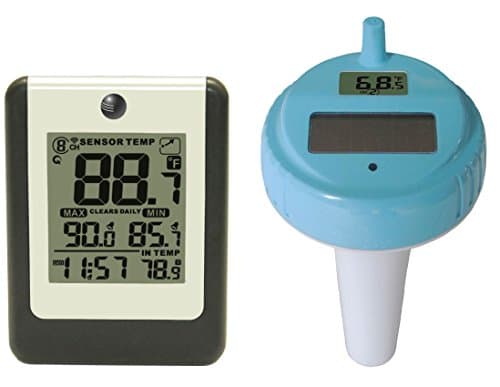 Best for water and air together Ambient Weather WS-14 Wireless Floating Pool and Spa Thermometer One console, up to eight sensors. Water and air side by side is the pair the heat-loss arithmetic needs. | Watching water and air temperature side by side, or a pool and a spa | |
| 3 | No photo Best on a tight budget Milliard Floating Pool Thermometer Analog float on a string. Nothing to pair or charge — and nothing to read unless you walk out to it. | A pool you walk past anyway, on the smallest possible budget | |
| 4 | 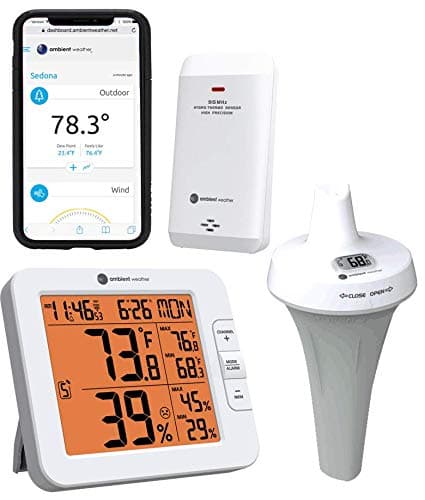 Best for logging the overnight curve Ambient Weather WS-8482 WiFi Weather Station with Floating Pool Thermometer WiFi station with the pool float included. Draws the cooling curve rather than leaving you two readings. | Logging the overnight curve rather than reading two numbers off a float | |
| 5 |  What the measurement usually tells you to buy Sun2Solar 1600 Series Ultimate Blue Solar Cover If the dusk-to-dawn drop is several degrees, this is the answer before any heater is. | An inground pool you cover most nights, every season |
#ad We earn a commission if you buy through this link, at no extra cost to you. It never changes the ranking. How this site is funded. Prices last checked October 17, 2026.
Why a thermometer is the first purchase, not an accessory
This site asks you to do one thing before buying any heater or cover: read the water temperature at dusk and again at dawn, a foot down and away from the returns, on a still clear night. That number tells you whether your problem is heat loss or heat supply, and the two have different answers costing very different money.
Most pool thermometers make that measurement possible. Only some make it likely. Nobody walks to the pool at 6am in April to read an analog float more than twice, and a measurement that does not get taken is worth exactly nothing. That is the axis we ranked on.
How we judged these
- Will the dawn reading actually happen? A wireless display indoors, or a logging app, turns the measurement from a chore into a glance. This is the criterion that reorders the list.
- What the maker publishes. Range, radio distance, waterproof rating, number of sensors. Some publish real numbers; some publish adjectives. We say which.
- Water and air together. The heat-loss physics runs on the gap between water and air temperature. A setup that shows both is worth more than one that shows the water alone.
- Price against the job. The measurement is worth hundreds of dollars in avoided mistakes. It does not need a hundreds-of-dollars instrument.
- What we did not rank on: accuracy. No listing in this category publishes an accuracy figure, and we have not measured one. For the overnight-drop measurement that matters less than it sounds, and we explain why below.
The limit every float shares
Wireless: the reading comes to you
The Inkbird IBS-P01R is the pick because Inkbird publishes what most of the category does not: a sensor range of -40 to 158°F, a receiver up to 300 feet away, one receiver for up to three floating sensors, and an IPX7 waterproof rating. The float has its own LCD, so it still works with the receiver in a drawer, and a WiFi gateway version exists for anyone who wants the graph. Batteries are not always in the box, and the 300 feet is line of sight — walls cut it.
The Ambient Weather WS-14 does the same job with a different emphasis: one console reads up to eight sensors, and the listed compatible sensors include a floating pool sensor, an air-temperature sensor and a wired probe. That is the combination the physics wants. Each extra sensor is a separate purchase, and the listings give no accuracy figure.
Analog: the honest budget answer
A Milliard floating thermometer is an analog dial in a float on a tether, in one of several shapes, and it is the thermometer most pools already have. There is nothing to pair, charge or configure. The bulb hangs a few inches under the float, which is marginally better than a surface-only sensor. Its entire weakness is behavioral: it only produces a number if you walk out and read it, and reading a two-degree change off an analog dial takes more confidence than most people have at dawn.
Logging: for the people who want the curve
The Ambient Weather WS-8482 is a WiFi weather station sold with the floating pool sensor included, logging it alongside indoor and outdoor temperature and humidity to an app. That is more instrument than the dusk-and-dawn measurement needs. What it uniquely gives you is the overnight curve — how fast the pool cools after dark, and whether a cover changed the slope — and alarms, so a cover left off becomes a notification. It costs accordingly, and it adds a WiFi setup and a cloud account to the list of things that can fail.
What the reading tells you to do
| Dusk-to-dawn drop | What it means | What to buy |
|---|---|---|
| Under about 1°F | The pool holds heat well; your problem is supply | A heater, sized to the gap |
| Around 2 to 3°F | Typical uncovered loss; mostly evaporation | A cover first, then re-measure |
| 4°F or more | Loss dominates; wind is probably involved | A cover, a windbreak, then re-measure |
About 70% of a pool’s heat loss is evaporation by the Department of Energy’s figure, so a large drop is usually a cover problem before it is a heater problem. The full decision tree, and what your drop is worth in dollars.
How to take the measurement properly
- Same spot, same times. Away from the returns and the skimmer, at dusk and at dawn, on a still clear night. Wind and cloud change the answer.
- Two nights uncovered, two nights covered, if you already own a cover. The difference between the two drops is what the cover is doing for your pool, which is a better number than any published saving.
- Note the air temperature too. The loss scales with the gap between water and air, which is why the two-sensor setups exist.
- Then decide. Whether a heater is worth it and which loss path to attack first both start from this number.
The one thing not to do
Do not buy a heater on the strength of a single afternoon reading. The afternoon temperature is the sun’s work and tells you almost nothing about where the heat goes. The overnight drop is the measurement, and every thermometer on this page exists to take it.
Every pick, in detail
What each one publishes, what is good and bad about it, and — the section this category usually omits — what we could not judge without owning one.
Inkbird IBS-P01R Wireless Floating Pool Thermometer
The floating sensor that sends the reading indoors, which is the feature that decides whether the dusk-and-dawn measurement this site keeps asking for actually happens. Inkbird publishes real numbers — a sensor range of -40 to 158°F, a receiver up to 300 feet away, one receiver for up to three floats — and the display on the float itself means it still works if the receiver is in a drawer. What it does not do is read the water a foot down: it reads the surface, like every float.
Best for Taking the overnight-drop measurement without walking to the pool
| Sensor range | -40 to 158°F | Manufacturer |
|---|---|---|
| Receiver range | Up to 300 ft, line of sight | Manufacturer |
| Floats per receiver | Up to three | Manufacturer |
| Waterproofing | IPX7 | Manufacturer |
| Reads at | The surface, where it floatsA floating thermometer measures the top inch. On a still evening that can run a degree or two warmer than the water a swimmer feels. Read it the same way every time and the trend is still right. | Published standard |
- Manufacturer publishes range, distance and waterproof rating — most of this category does not
- Display on the float and on the receiver, so it works with or without the base
- A WiFi gateway version exists for logging and alarms if you want the graph
- Reads the surface, not the water at swimming depth
- Batteries in both float and receiver, and not always included
- Radio range is quoted line of sight; walls and metal cut it
- Long-term seal life on a float that sits in chlorinated water all season
- Accuracy against a reference thermometer — Inkbird states an app calibration exists, not a factory figure
- Battery life in a hot climate
These need a unit in hand across a season. We do not have one, so we do not have an opinion worth printing on them.
#ad We earn a commission if you buy through this link, at no extra cost to you. It never changes the ranking. How this site is funded. Prices last checked October 17, 2026.
Ambient Weather WS-14 Wireless Floating Pool and Spa Thermometer
The multi-channel option: one console that reads up to eight sensors, so the pool float, a spa float and an air-temperature sensor can share a display. That is exactly the setup the physics on this site wants, because the number that matters for heat loss is the gap between the water and the air, and this is the cheapest way to have both on one screen. Its floats and sensors are add-on purchases, which is either the point or the catch depending on how many you want.
Best for Watching water and air temperature side by side, or a pool and a spa
| Sensors per console | Up to eightFloating pool sensor, air temperature sensor and wired probe are all listed as compatible. The base kit ships with one float; the WS-14-X2 ships with two. | Retail listing |
|---|---|---|
| Float type | Wireless, floats on the surfaceThe manufacturer publishes no retrievable specification sheet; figure is as listed at retail. | Retail listing |
| Reads at | The surfaceSame caveat as every float: it measures the top inch. Consistent placement keeps the trend honest. | Published standard |
- Water and air temperature on one console, which is the pair the heat-loss arithmetic needs
- Expands to a spa or a second pool without a second display
- Two-float kit sold for people who want the redundancy
- Each additional sensor is a separate purchase
- No published accuracy figure in the listings
- Surface reading only
- Float seal life across a season in treated water
- Real radio range through your house's walls
- Accuracy against a reference
These need a unit in hand across a season. We do not have one, so we do not have an opinion worth printing on them.
#ad We earn a commission if you buy through this link, at no extra cost to you. It never changes the ranking. How this site is funded. Prices last checked October 17, 2026.
Milliard Floating Pool Thermometer
The analog float on a string, which is the thermometer most pools already have and the one to buy if you will genuinely walk out and look at it twice a day. There is nothing to pair, nothing to charge and nothing to fail except the seal, and it costs a fraction of any wireless option. The trade is entirely behavioral: the reading only exists if you go and read it, and the whole point of the measurement is taking it at dawn.
Best for A pool you walk past anyway, on the smallest possible budget
| Type | Analog float with tether stringThe manufacturer publishes no retrievable specification sheet; figure is as listed at retail. | Retail listing |
|---|---|---|
| Reads at | Just below the surfaceThe bulb hangs a few inches under the float, which is marginally better than a surface-only sensor and still not swimming depth. | Published standard |
| Reading scale | Fahrenheit and Celsius, large print | Retail listing |
- Cheapest thing on this site that produces a number you can act on
- No batteries, no pairing, no app
- The bulb sits a few inches under the surface, which helps a little
- You have to go to the pool to read it, and at dawn most people do not
- Analog scale — a two-degree overnight drop is hard to read with confidence
- The tether and the seal are the failure points, and they are cheap parts
- Accuracy against a reference thermometer
- How many seasons the seal lasts in chlorinated water
- Whether the novelty shapes affect how level it floats
These need a unit in hand across a season. We do not have one, so we do not have an opinion worth printing on them.
#ad We earn a commission if you buy through this link, at no extra cost to you. It never changes the ranking. How this site is funded. Prices last checked October 17, 2026.
Ambient Weather WS-8482 WiFi Weather Station with Floating Pool Thermometer
The logging option: a WiFi station that records the pool float alongside indoor and outdoor temperature and humidity, and puts the graph on your phone. For most pools it is more instrument than the job needs. For anyone who actually wants to see the overnight curve — how fast the pool cools after dusk, whether a cover changed the slope — it is the only pick on this page that draws that curve for you rather than leaving you with two readings and a subtraction.
Best for Logging the overnight curve rather than reading two numbers off a float
| Channels | Seven, with the floating pool sensor includedThe manufacturer publishes no retrievable specification sheet; figure is as listed at retail. | Retail listing |
|---|---|---|
| Connectivity | WiFi, with app and cloud logging | Retail listing |
| Also measures | Indoor and outdoor temperature and humidity | Retail listing |
| Reads at | The surface | Published standard |
- Logs the whole overnight curve, which no float-and-console kit does
- Air temperature and humidity alongside the water — the evaporation drivers
- Alarms, so a cover left off becomes a notification rather than a surprise
- Considerably more money than the question usually deserves
- WiFi setup and a cloud account, which is a different kind of failure mode
- Surface reading only, like every float
- Float seal life in treated water
- Whether the WiFi holds at the distance your pool sits from the router
- Accuracy against a reference
These need a unit in hand across a season. We do not have one, so we do not have an opinion worth printing on them.
#ad We earn a commission if you buy through this link, at no extra cost to you. It never changes the ranking. How this site is funded. Prices last checked October 17, 2026.
Sun2Solar 1600 Series Ultimate Blue Solar Cover
The cover to buy if you intend to keep using it in five years. 16 mil is the thickest tier the category sells, and thickness on a solar cover buys durability rather than heat — Bob Vila measured every cover in its hands-on group at the same 4 to 5 degrees, from 12-mil clear to 16-mil blue. Pay the extra for the one that survives being dragged over the coping twice a day, not for a temperature difference that did not show up in the only published one-hour test in this category.
Best for An inground pool you cover most nights, every season
| Price shown for | 24 ft roundThis product is sold in several sizes on one listing. The live price and photograph on this page are the ones Amazon returns for this variant; other sizes are priced separately. | Retail listing |
|---|---|---|
| Thickness | 16 milThe manufacturer publishes no retrievable specification sheet; figure is as listed at retail. | Retail listing |
| Color | Blue | Retail listing |
| Stated lifespan | 5 to 10 years for the 16-mil tierSwim University's published figure for 16-mil covers generally, not a Sun2Solar warranty statement. | Retail listing |
| Bubble side | Bubbles face the waterCategory-wide instruction, not brand-specific. The bubbles are the insulating layer and they have to touch the water. | Published standard |
4 to 5 degrees F in one hour
Claimed by Bob Vila, measured across all covers in their group. Conditions: One hour under 2pm sun on 89 to 92 degree F days. Source
Their figure was the same for every cover they put on the water. Read our reconciliation of what a one-hour reading actually measures before you plan around this number.
- Thickest tier sold, which is where the durability difference actually is
- Blue absorbs more of the incoming energy at the surface than clear does
- Cuts oversize to your pool shape with household scissors
- Heavy and awkward at 16 mil — a large inground cover is genuinely a two-person job without a reel
- Costs meaningfully more than the 12-mil version for no measured heating advantage
- Whether the seams hold up over five seasons of daily handling
- How the bubble layer survives repeated dragging over rough coping
- Whether the stated lifespan tier holds for this specific product line
These need a unit in hand across a season. We do not have one, so we do not have an opinion worth printing on them.
#ad We earn a commission if you buy through this link, at no extra cost to you. It never changes the ranking. How this site is funded. Prices last checked October 17, 2026.
Questions people actually ask
What is the best pool thermometer?
Are wireless pool thermometers accurate?
Why does my floating thermometer read warmer than the water feels?
How much does a pool lose overnight?
Do I need a pool thermometer with an app?
- Inkbird IBS-P01R wireless pool thermometer product page: -40 to 158°F sensor range, receiver up to 300 ft, one receiver pairs with up to three floating transmitters, IPX7Inkbird · read 2026-09-12
- U.S. Department of Energy pool-energy figures (evaporation share, BTU per pound evaporated, cover savings, recommended temperatures, wind effect)Recreonics, reproducing and attributing the U.S. Department of Energy · read 2026-09-02
- Water density: 62.424 pounds per cubic foot at 39.2°FU.S. Geological Survey, Water Science School · read 2026-09-02
Every URL above was fetched and returned content on the date shown. Where a figure is ours rather than somebody else’s, the arithmetic is on the page and on the methodology page. If you find an error in it, we would genuinely like to know.
Read next
Your pool is too cold. Start here.
A decision tree rather than an essay: four measurements that identify which problem your cold pool actually has, and what each one costs to fix.

How fast a pool loses heat
Evaporation, radiation, convection and conduction, with the arithmetic on what each night actually costs and a measurement you can take yourself.
Keeping a pool warm overnight
The specific problem of overnight heat loss: what causes it, what each fix is worth, and the order to try them in.
How to keep a pool warm
Four loss paths take heat out of a pool and they are not equal. What addresses each one, ranked by effect per dollar, and the operating choices that matter more than equipment.

The ideal pool temperature
DOE's recommended ranges for swimming and for lounging, why they differ, and the 10-to-30%-per-degree figure that makes the setpoint the biggest lever you own.