Liquid solar covers
A film one molecule thick, doing one job. Judge it against your overnight loss, not against what happens in the afternoon.
Quick picks
Two liquid products that work identically, plus the physical alternative for anyone whose real objection is handling a blanket.
| # | Product | Best for | Price |
|---|---|---|---|
| 1 | No photo The established one HeatSavr Liquid Solar Cover The monolayer product most people mean when they say liquid cover. | Odd-shaped pools and anyone who will never use a blanket | |
| 2 | 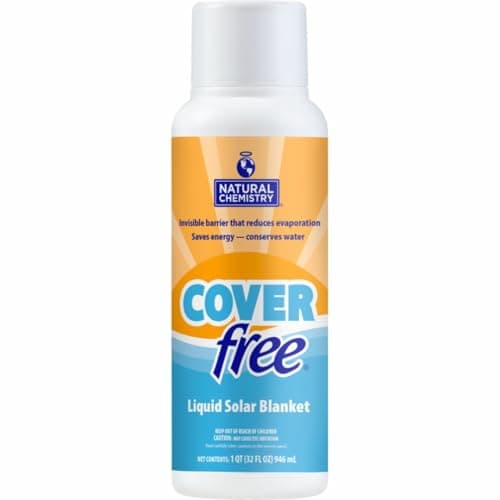 The alternative Cover Free Liquid Solar Blanket Same mechanism. Buy whichever is cheaper on the day. | The same job as HeatSavr, when it is cheaper on the day | |
| 3 | 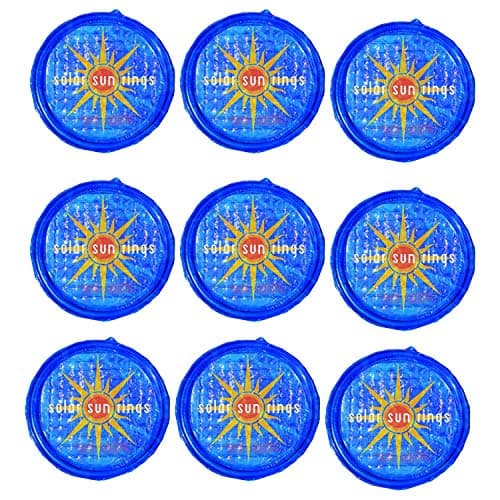 The physical option Solar Sun Rings If the reason you want liquid is that blankets are a hassle, rings are a middle ground. | A pool you would otherwise leave uncovered because the blanket is too much work |
#ad We earn a commission if you buy through this link, at no extra cost to you. It never changes the ranking. How this site is funded. Prices last checked October 18, 2026.
The mechanism, properly
A liquid solar cover is a self-spreading chemical — typically an alcohol-based compound — that forms a layer roughly one molecule thick across the water surface. That film interferes with evaporation: water molecules leaving the surface have to get past it, and fewer of them do.
That is the whole mechanism, and understanding it settles what to expect from the product. Because evaporation is the mechanism, this is an overnight-retention product and nothing else. It is optically negligible: a monolayer does not absorb sunlight, does not trap air, and does not insulate. It cannot warm your pool during the day the way a physical cover can, and any marketing that implies otherwise is selling you the wrong mental model.
What we cannot tell you, and neither can anyone else
We could not find a retrievable, independent measurement of how much evaporation a liquid cover suppresses on a residential pool. Not a manufacturer figure, not a university study, not a testing-lab result. The claims in circulation trace back to product marketing.
So the honest position is: the mechanism is real and the physics are sound, and the magnitude is unquantified. We are not going to put a percentage on it, and you should be suspicious of anyone who does without saying where it came from.
The disruption problem
A monolayer is fragile by definition. Three things break it up:
- Swimmers. Anybody in the pool destroys the film in their vicinity immediately.
- Wind. Surface movement pushes the film to one end. DOE’s figure that a 7 mph wind can raise pool energy consumption by 300% is about evaporation in general, and a monolayer is the least robust defense against exactly that.
- Return jets. Your circulation is agitating the surface whenever the pump runs.
The film re-forms on its own — that is what “self-spreading” means — but it takes time, and during that time you have no cover at all. On a busy pool with an aggressive return, that may be a large fraction of the time.
When it is the right buy
Liquid covers are genuinely the answer in three situations:
- A shape no blanket fits. Freeform pools with islands, grottos, or a lot of hardscape in the water. A liquid cover does not care about shape.
- A pool where a blanket cannot be stored. No deck space, no reel position, nowhere for a rolled cover to live.
- Alongside a blanket. Nothing stops you using both, and the liquid covers the hours the blanket is off.
It is the wrong buy if what you actually want is warmer water during the day. For that you want a physical cover, or solar panels, or a heater — the liquid is not in that conversation.
Safety and chemistry
These are pool chemicals and should be treated as such: dose per the label, keep the container away from children, and do not assume more is better — a monolayer is one molecule thick by definition and overdosing does not make it thicker.
The label is also where the genuinely useful information in this category lives. Our review of Natural Chemistry’s Coverfree works its published dose rate into bottles per season for three pool sizes, and takes apart the two percentages its retail listings print — which, checked against each other, cannot both be right.
Every pick, in detail
What each one publishes, what is good and bad about it, and — the section this category usually omits — what we could not judge without owning one.
HeatSavr Liquid Solar Cover
A monolayer chemical that spreads a molecule-thick film across the surface to slow evaporation. It is the only option here that does not require you to physically cover anything, which is exactly why people buy it — and it is also the reason to be careful with the claims: a film that thin is disrupted by swimmers, wind and the return jets, and it is doing nothing for the hours after that until it re-spreads.
Best for Odd-shaped pools and anyone who will never use a blanket
| How it works | Self-spreading monolayer that slows surface evaporation | Published standard |
|---|---|---|
| Typical price | About $10 to $30 or moreSwim University's published range for liquid covers generally, read 2026-09-02. | Retail listing |
| Effect on daytime gain | None to speak ofA monolayer is optically negligible. Any benefit is on the evaporation side, which is the overnight-retention mechanism, not daytime gain. | Our arithmetic |
- Works on any pool shape, including the ones no blanket fits
- Nothing to store, fold, drag or trip over
- Cheap enough to try
- Disrupted by swimming, wind and circulation, and takes time to re-form
- Nothing published that would let you quantify what it actually saves
- Does not warm the pool during the day the way a physical cover can
- How much evaporation it actually suppresses on a real pool
- How quickly the film re-forms after use
- Whether dosing frequency in practice matches the label
These need a unit in hand across a season. We do not have one, so we do not have an opinion worth printing on them.
#ad We earn a commission if you buy through this link, at no extra cost to you. It never changes the ranking. How this site is funded. Prices last checked October 18, 2026.
Cover Free Liquid Solar Blanket
The other liquid cover people search for, and it works on the same monolayer principle as HeatSavr. Everything true of that one is true of this one, including the honest caveat: the mechanism is evaporation suppression, so judge it against your overnight loss, not against what happens in the afternoon.
Best for The same job as HeatSavr, when it is cheaper on the day
| Price shown for | 1 quartThis product is sold in several sizes on one listing. The live price and photograph on this page are the ones Amazon returns for this variant; other sizes are priced separately. | Retail listing |
|---|---|---|
| How it works | Self-spreading monolayer that slows surface evaporation | Published standard |
| Effect on daytime gain | None to speak ofSame reasoning as HeatSavr: a monolayer is optically negligible. | Our arithmetic |
- No physical cover to handle at all
- Fits any pool shape by definition
- Same disruption problem as every monolayer product
- No retrievable data on how much it actually saves
- Measured evaporation reduction on a real pool
- Whether it differs from HeatSavr in any way that matters
These need a unit in hand across a season. We do not have one, so we do not have an opinion worth printing on them.
#ad We earn a commission if you buy through this link, at no extra cost to you. It never changes the ranking. How this site is funded. Prices last checked October 18, 2026.
Solar Sun Rings
Floating discs you drop on one at a time instead of wrestling a full blanket, sold individually. That convenience is the whole product, and it comes out of the physics: rings leave gaps, and evaporation carries on through every square foot you did not cover. Expect a fraction of a full cover's effect roughly in proportion to the surface you actually covered, and buy them because you will use them, not because they work better.
Best for A pool you would otherwise leave uncovered because the blanket is too much work
| Price shown for | One 60-inch ringSolar Sun Rings list this 60-inch ring by pack count, each pack its own listing: single, 3, 6 and 9. The live price and photograph on this page are the ones Amazon returns for the single-ring listing; the multi-ring packs are priced separately and work out cheaper per ring. | Retail listing |
|---|---|---|
| Coverage | Partial — discs leave gaps between and at the edgesThe gap is not a defect, it is how the product works. It does mean the DOE cover-saving figures do not apply at full strength. | Published standard |
| Typical price | About $40 to $55 each, or about $150 and up per multi-ring packRead from the brand's own current Amazon listings on 2026-10-12: $54.99 for the single ring, and $149.97, $269.94 and $359.91 for the 3, 6 and 9-ring packs — about $40 to $50 a ring as the pack gets larger. Check the live price before buying. | Retail listing |
- One person can put them on and take them off in a couple of minutes
- No reel, no folding, no dragging anything over the coping
- Buy a few at a time instead of committing to one large purchase
- Partial coverage means partial results — the gaps keep evaporating
- Per square foot of coverage they cost far more than a blanket
- Wind moves them around
- How much surface a given number of rings really covers on your pool shape
- How long the material lasts against a full blanket
- Whether the anchoring holds in a breeze at your site
These need a unit in hand across a season. We do not have one, so we do not have an opinion worth printing on them.
#ad We earn a commission if you buy through this link, at no extra cost to you. It never changes the ranking. How this site is funded. Prices last checked October 18, 2026.
Questions people actually ask
Do liquid solar covers actually work?
Will a liquid cover heat my pool during the day?
Is a liquid cover safe to swim in?
Can I use a liquid cover and a solar blanket together?
- U.S. Department of Energy pool-energy figures (evaporation share, BTU per pound evaporated, cover savings, recommended temperatures, wind effect)Recreonics, reproducing and attributing the U.S. Department of Energy · read 2026-09-02
- U.S. Department of Energy, Energy Saver: Swimming Pool Covers (archived — the live page now returns 404)U.S. Department of Energy via the Internet Archive · read 2026-09-02
- Hands-on solar cover comparison: 4 to 5°F measured in one hour of 2pm sun on 89–92°F days, with the method statedBob Vila · read 2026-09-02
- Solar cover guide: 0.7°F per hour under noontime sun, 10–15°F held, and published lifespan tiers by thicknessSwim University · read 2026-09-02
- Water density: 62.424 pounds per cubic foot at 39.2°FU.S. Geological Survey, Water Science School · read 2026-09-02
Every URL above was fetched and returned content on the date shown. Where a figure is ours rather than somebody else’s, the arithmetic is on the page and on the methodology page. If you find an error in it, we would genuinely like to know.
Read next
Cover Free liquid solar blanket review
Natural Chemistry's Coverfree: the weekly dose arithmetic nobody works out, how long a quart really lasts on your pool, and why the 85% and 70% claims on the same listing are not consistent.

Solar sun rings
Floating rings you deploy one at a time. What the gaps between them cost you in evaporation, what they cost per square foot covered, and when they are the right answer anyway.
Solar pool covers worth buying
Ranked on the specifications that actually differ between covers — thickness tier and published lifespan — because the only hands-on test in this category found no heating difference at all.
Keeping a pool warm overnight
The specific problem of overnight heat loss: what causes it, what each fix is worth, and the order to try them in.
How fast a pool loses heat
Evaporation, radiation, convection and conduction, with the arithmetic on what each night actually costs and a measurement you can take yourself.
Do solar pool covers work?
The 4-degrees-versus-15-degrees contradiction that runs through this entire category, reconciled from published physics. Three different quantities being reported as one.