Solar cover: bubbles up or down?
Bubbles down, against the water. Every time. Here is the reason, and what happens if you get it wrong.
Quick picks
One pick, because this page is a two-sentence answer rather than a shopping decision.
| # | Product | Best for | Price |
|---|---|---|---|
| 1 | 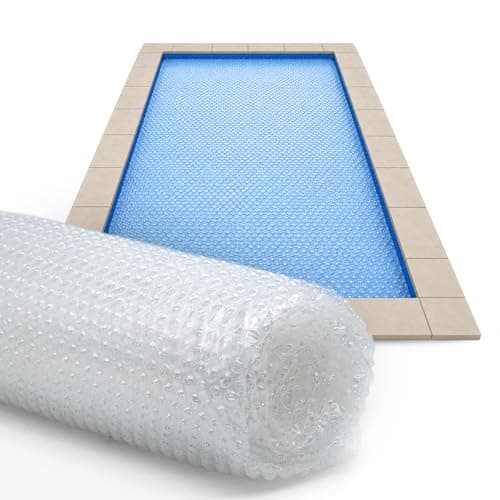 If you are here because you need a cover Sun2Solar 1200 Series Crystal Clear Solar Cover The 12-mil clear cover we would buy. Bubbles down. | Most pools, most budgets — the default recommendation |
#ad We earn a commission if you buy through this link, at no extra cost to you. It never changes the ranking. How this site is funded. Prices last checked October 17, 2026.
The answer
Bubbles down, against the water. The smooth side faces up at the sky. This has never been in dispute among manufacturers, retailers or anyone who has tried it both ways, and Swim University’s instruction is the standard one: “spread it out bubble-side down on top of the pool water.”
Why
The bubbles are not decoration and they are not there to catch sunlight. They are the insulating layer, and they do two jobs that both require contact with the water:
- They trap air. Each bubble is a small pocket of still air between the water and the outside world. Still air is a poor conductor of heat, which is the same principle behind double glazing and every insulated jacket you own. Trapped air only insulates if it is between the two things you want to separate.
- They hold the film against the surface. The bubbles give the cover a slightly buoyant, conforming shape that sits down on the water rather than floating loose over it. That contact is what blocks evaporation — and evaporation is about 70% of a pool’s heat loss, per DOE, which makes it the main event.
What happens if you put it on upside down
Nothing dramatic, which is exactly why the question keeps getting asked: a cover installed bubbles-up still floats and still looks like it is working.
What you lose is most of the benefit. The flat film on the water is a thin, poorly-sealing barrier with no trapped air behind it. Evaporation suppression drops. The insulating layer is now sitting on top exposed to the air rather than between the water and the sky. You have a floating sheet of plastic rather than a cover.
You will also damage it faster. The bubble side is the structural side, and leaving the bubbles exposed to direct UV and to being walked on shortens the life of the cover.
The related question people mean to ask
Often what someone actually wants to know is whether the cover should be on the pool at all during the day, which is a genuinely more interesting question with a slightly more interesting answer. We cover it here. Short version: yes, unless you are swimming or the pool is already above your target.
If you want the full mechanism — why the bubbles matter, how much energy each process actually moves — the mechanism page works it through with the arithmetic.
Every pick, in detail
What each one publishes, what is good and bad about it, and — the section this category usually omits — what we could not judge without owning one.
Sun2Solar 1200 Series Crystal Clear Solar Cover
The value pick, and the one whose logic actually holds up. A clear cover transmits more sunlight into the body of the pool instead of absorbing it at the surface, and 12 mil is the point where lifespan stops being the limiting factor. Bob Vila measured this and the 16-mil blue at the same 4 to 5 degrees in an hour, so you are paying less for the same measured result and giving up some years of service life.
Best for Most pools, most budgets — the default recommendation
| Price shown for | 20 x 40 ft rectangleThis product is sold in several sizes on one listing. The live price and photograph on this page are the ones Amazon returns for this variant; other sizes are priced separately. | Retail listing |
|---|---|---|
| Thickness | 12 milThe manufacturer publishes no retrievable specification sheet; figure is as listed at retail. | Retail listing |
| Color | Clear | Retail listing |
| Stated lifespan | 3 to 4 years for the 12-mil clear tierSwim University's published figure for 12-mil clear covers generally. | Retail listing |
| Bubble side | Bubbles face the water | Published standard |
4 to 5 degrees F in one hour
Claimed by Bob Vila, measured across all covers in their group. Conditions: One hour under 2pm sun on 89 to 92 degree F days. Source
- Clear transmits more light into the water instead of stopping it at the surface
- 12 mil is the sweet spot: real service life without 16-mil bulk
- Cheaper than the 16-mil tier with no measured heating penalty
- Shorter published lifespan tier than 16 mil
- A clear cover shows algae and debris more obviously, which some people dislike
- Whether clear genuinely outlasts or under-lasts blue in the same thickness
- Real-world tear resistance at a pool with rough edges
- How much the clear material clouds over a season of UV
These need a unit in hand across a season. We do not have one, so we do not have an opinion worth printing on them.
#ad We earn a commission if you buy through this link, at no extra cost to you. It never changes the ranking. How this site is funded. Prices last checked October 17, 2026.
Questions people actually ask
Do solar cover bubbles go up or down?
What happens if the bubbles face up?
How do I tell which side is which?
- Solar cover guide: 0.7°F per hour under noontime sun, 10–15°F held, and published lifespan tiers by thicknessSwim University · read 2026-09-02
- U.S. Department of Energy pool-energy figures (evaporation share, BTU per pound evaporated, cover savings, recommended temperatures, wind effect)Recreonics, reproducing and attributing the U.S. Department of Energy · read 2026-09-02
Every URL above was fetched and returned content on the date shown. Where a figure is ours rather than somebody else’s, the arithmetic is on the page and on the methodology page. If you find an error in it, we would genuinely like to know.
Read next
How a solar cover heats a pool
Transmission during the day, evaporation suppression at night. The two mechanisms separated, with the energy arithmetic for each.
Solar cover on or off during the day?
Why leaving the cover on during daylight is usually right, the two situations where it is not, and what wind does to the calculation.
Solar pool covers worth buying
Ranked on the specifications that actually differ between covers — thickness tier and published lifespan — because the only hands-on test in this category found no heating difference at all.
Do solar pool covers work?
The 4-degrees-versus-15-degrees contradiction that runs through this entire category, reconciled from published physics. Three different quantities being reported as one.